The Bolands and the Johnsons came to Cascade County with the city itself: a Swedish miner who walked from Seattle, homesteaded in the Tiger Butte country and served as a county commissioner, and Irish families who worked the smelter at Black Eagle. In 1979 Thomas E. Boland opened a law practice in Great Falls. Today that practice is Boland Aarab PLLP, its successor firm, led by his daughter Caitlin Boland Aarab and Samir F. Aarab.
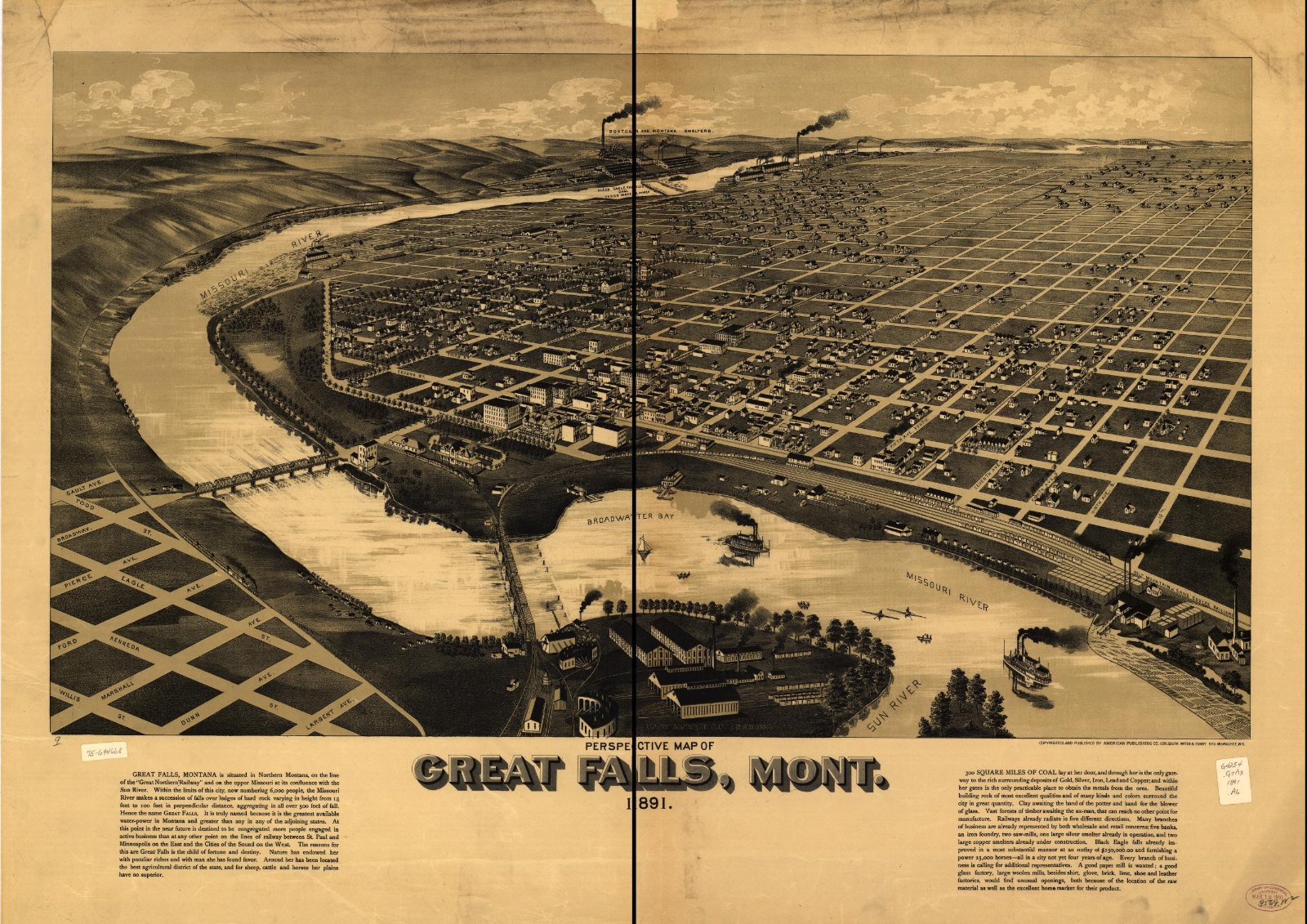
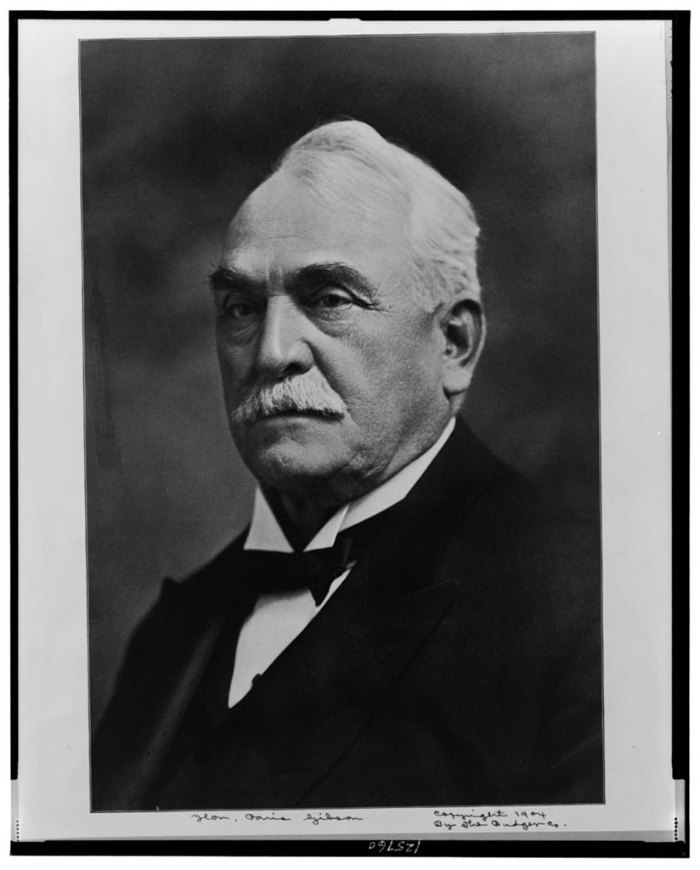
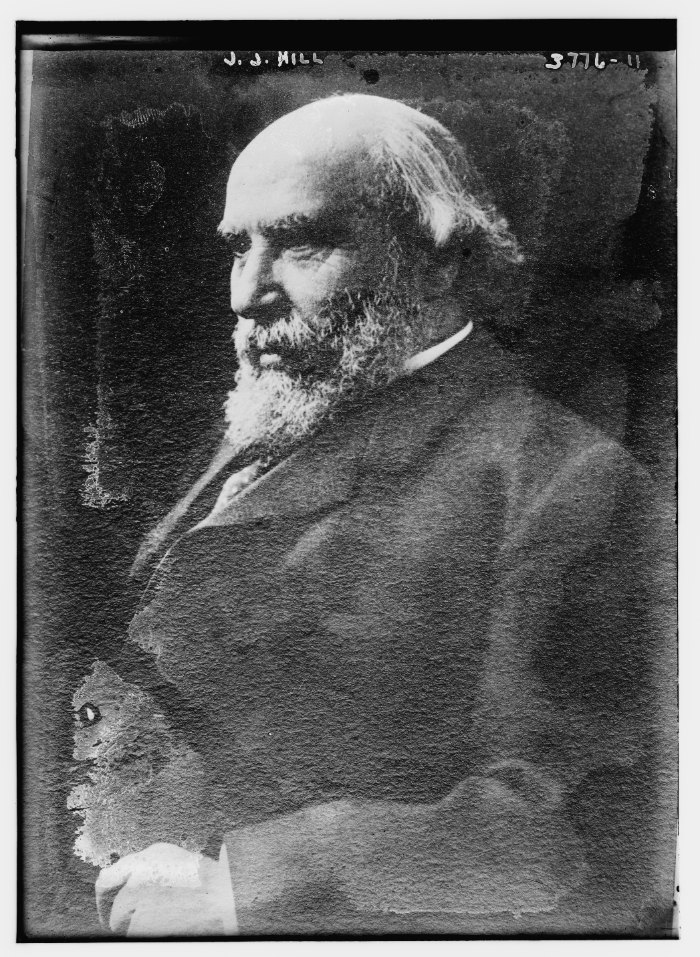
In 1880 Paris Gibson, a Minneapolis businessman then living at Fort Benton, rode to the falls of the Missouri and saw the power for an industrial city. Backed by the railroad builder James J. Hill, he had the townsite platted in 1883. Hill’s St. Paul, Minneapolis & Manitoba Railway, soon to be the Great Northern, laid its first rails into Great Falls in October 1887. The city incorporated on November 28, 1888, with Gibson as its first mayor.
Hill’s railroad also ran a branch to the Sand Coulee coal field, and the coal, the smelters and the railroad drew immigrants by the thousands: Finns, Norwegians and Swedes to the coal camps at Sand Coulee, Belt and Stockett; Italians, Croatians, Irish and others to the smelter at Black Eagle; homesteaders to the benchland in between. Both of the families behind this firm came with that first wave.
Great Falls in 1891, eight years after the townsite was platted.Library of Congress, Geography and Map DivisionParis Gibson.Library of Congress, Prints & Photographs Division, LC-USZ62-125760James J. Hill, 1915.Library of Congress, George Grantham Bain Collection
1879–1886
Pete Johnson walks to Montana
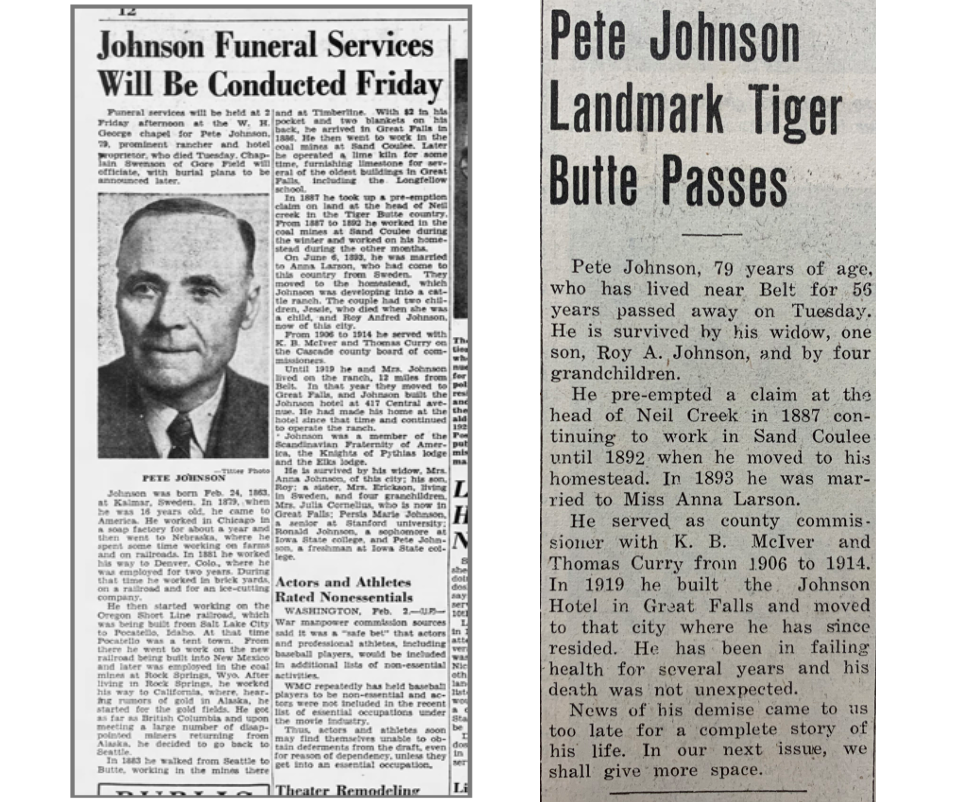
Pete Johnson, Caitlin Boland Aarab’s great-great-grandfather on her mother’s side, was born in Kalmar, Sweden, on February 24, 1863. He came to America alone at sixteen. He worked in a Chicago soap factory, on Nebraska farms and railroads, in Denver brickyards, on the Oregon Short Line and in the coal mines at Rock Springs, Wyoming. He set out for the Alaska gold fields, met disappointed miners coming back through British Columbia, and turned around.
In 1883 he walked from Seattle to Butte and worked in the mines there and at Timberline. In 1886 he came into Cascade County on foot, driving a freight team up from Helena, with two dollars and two blankets on his back.
1887–1919
Tiger Butte and Neill Creek
Johnson worked the Sand Coulee coal mines and ran a lime kiln that supplied limestone for some of the city’s first buildings, including the Longfellow School. In 1887 he filed a claim at the head of Neill Creek, in the Tiger Butte country of the Little Belt foothills south of Belt, and spent winters in the mines until he could move onto the land in 1892.
He was not alone. A neighbor’s 1924 obituary recalled coming over from Sweden with his brother and Pete Johnson, working the mine at Timberline, and taking up ranches side by side. In 1893 Johnson married Anna Larson, who had also come from Sweden. Their daughter Jessie was born in 1894, and their son Roy was born on the ranch in 1895. Federal land patents issued to Pete Johnson in 1895, 1903 and 1907 trace the claim as it grew into a cattle ranch twelve miles from Belt. Jessie died in 1906, at twelve.
Pete Johnson’s obituaries, February 1943.Family collection
1906–1914
County commissioner, and a lesson in accountability
From 1906 to 1914 Johnson served on the Cascade County Board of Commissioners with K. B. McIver and Thomas Curry. Years later, Curry’s obituary noted that people still spoke of the businesslike way the three ran the county.
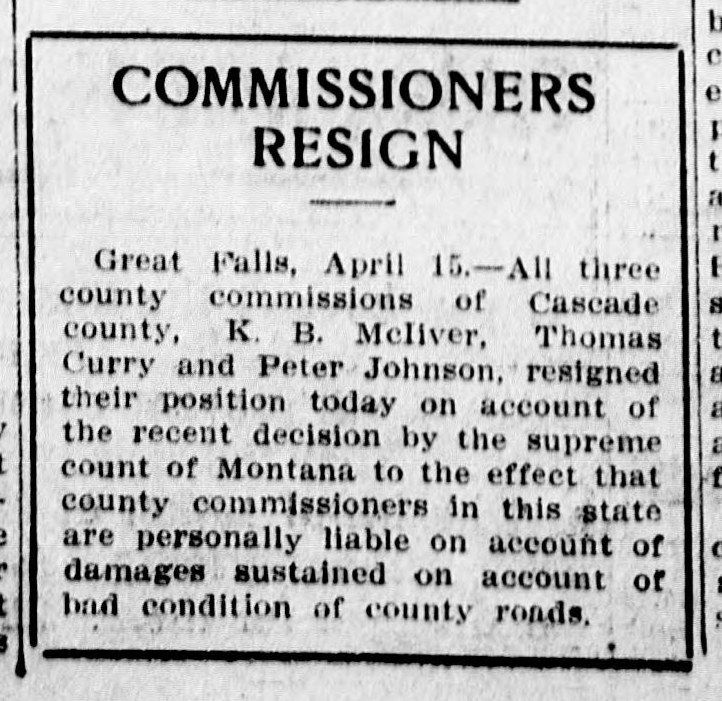
In April 1912 all three resigned in a single day. The Montana Supreme Court had just held, in Smith v. Zimmer, that county commissioners could be personally liable to people hurt on defective county roads. On rehearing that May, the Court let the commissioners out of the case, and the board stayed in office through 1914. The question at the center of that episode, who answers when an unsafe road hurts someone, is still one this firm litigates.
“Commissioners Resign,” Daily Missoulian, April 16, 1912, page 8. The front page that morning was the sinking of the Titanic.Library of Congress, Chronicling America
1919–1943
The Johnson Hotel
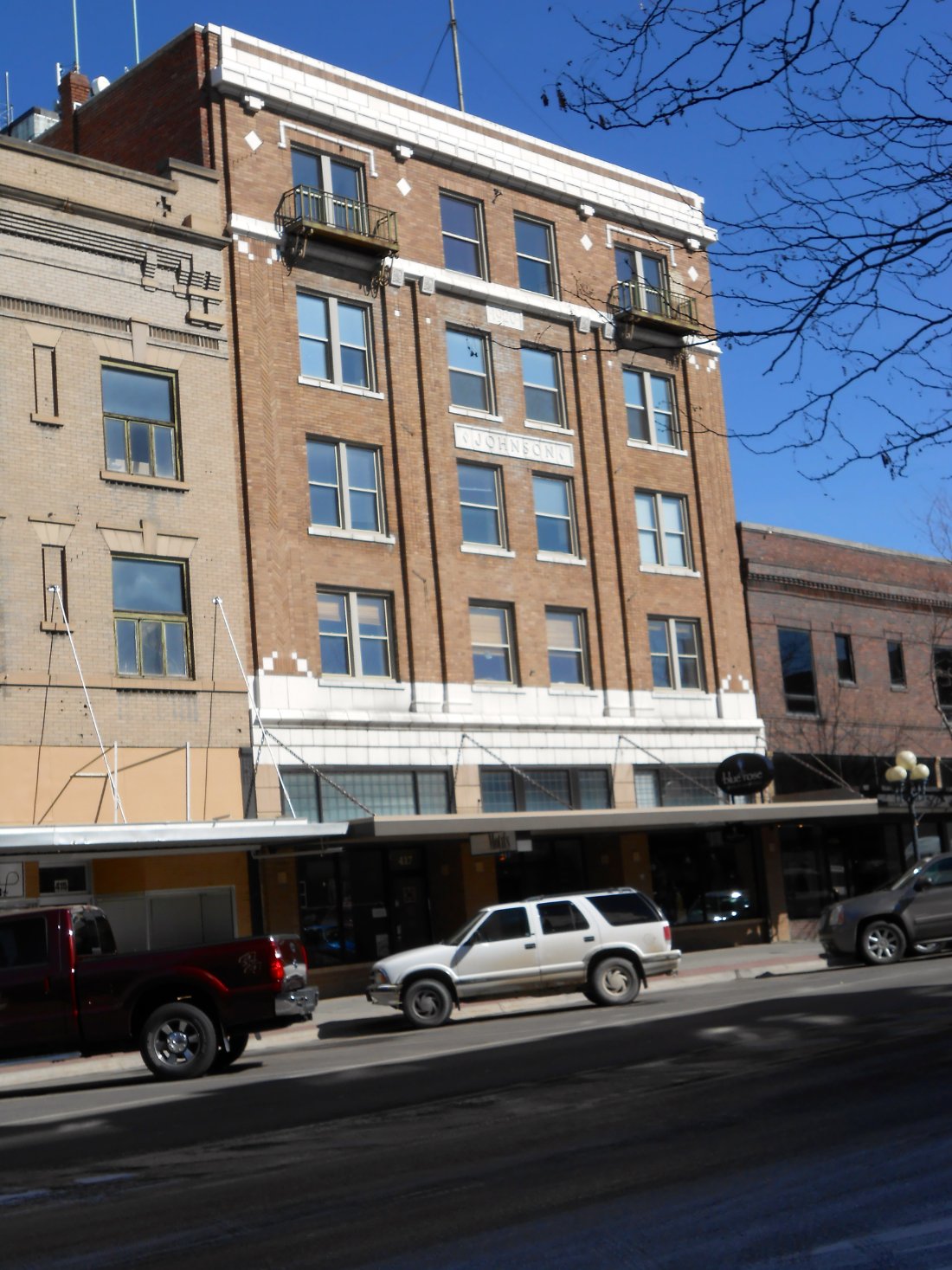
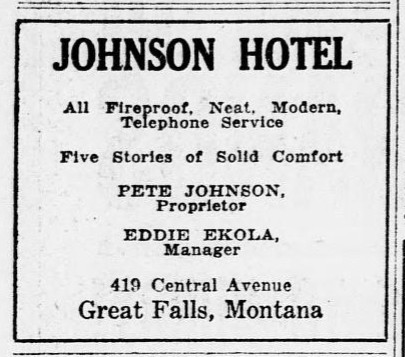
In 1919 Pete and Anna Johnson moved to town, and he built the Johnson Hotel at 417–419 Central Avenue: five stories, 112 rooms, fireproof, designed by the Great Falls architect George H. Shanley. It opened in 1920 as “Five Stories of Solid Comfort,” with Pete Johnson as proprietor. Family tradition holds that he built it for the farmers and ranchers who came to town dusty from the road and were not always welcome elsewhere.
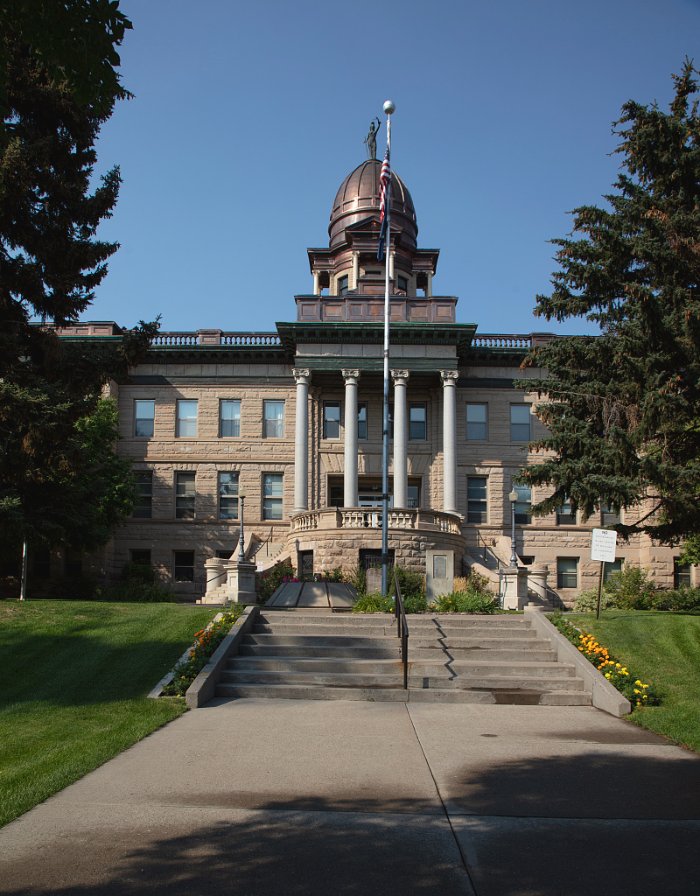
He lived at the hotel, kept the ranch, and sat on the board of the American Bank & Trust Company. Roy ran the ranch until 1928 and then the hotel. Pete Johnson died on February 2, 1943, at seventy-nine, and is buried with Anna at Tiger Butte Cemetery. The Johnson was a hotel for 48 years. The building still stands on Central Avenue, his name still carved in its stone, and it marked its centennial in 2020. A photograph of him in a fur coat hangs in the Cascade County Courthouse.
The Johnson Building today, 417 Central Avenue.Photo: Montanabw / Wikimedia Commons, CC BY-SA 3.0The Cascade County Courthouse, where Pete Johnson’s portrait hangs.Carol M. Highsmith Archive, Library of CongressJohnson Hotel advertisement, Great Falls Daily Tribune, November 17, 1920.Library of Congress, Chronicling America
1891–1982
The Bolands and Black Eagle
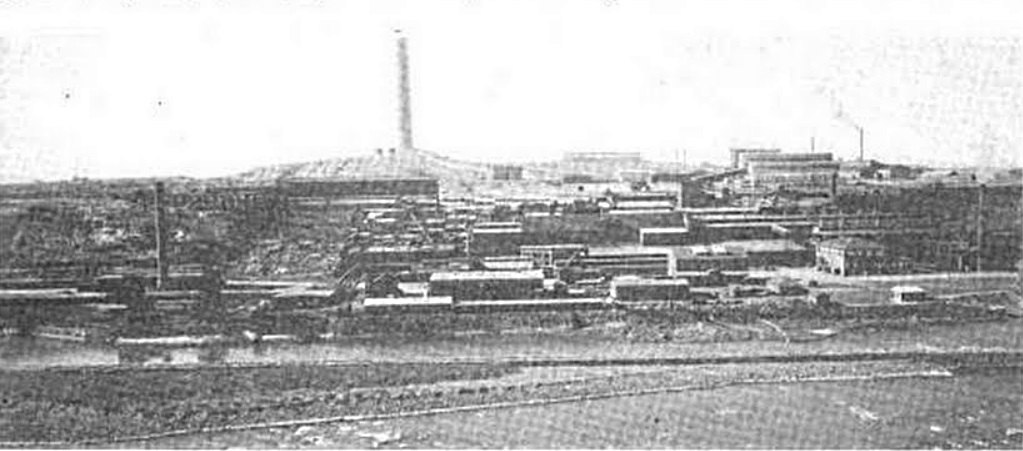
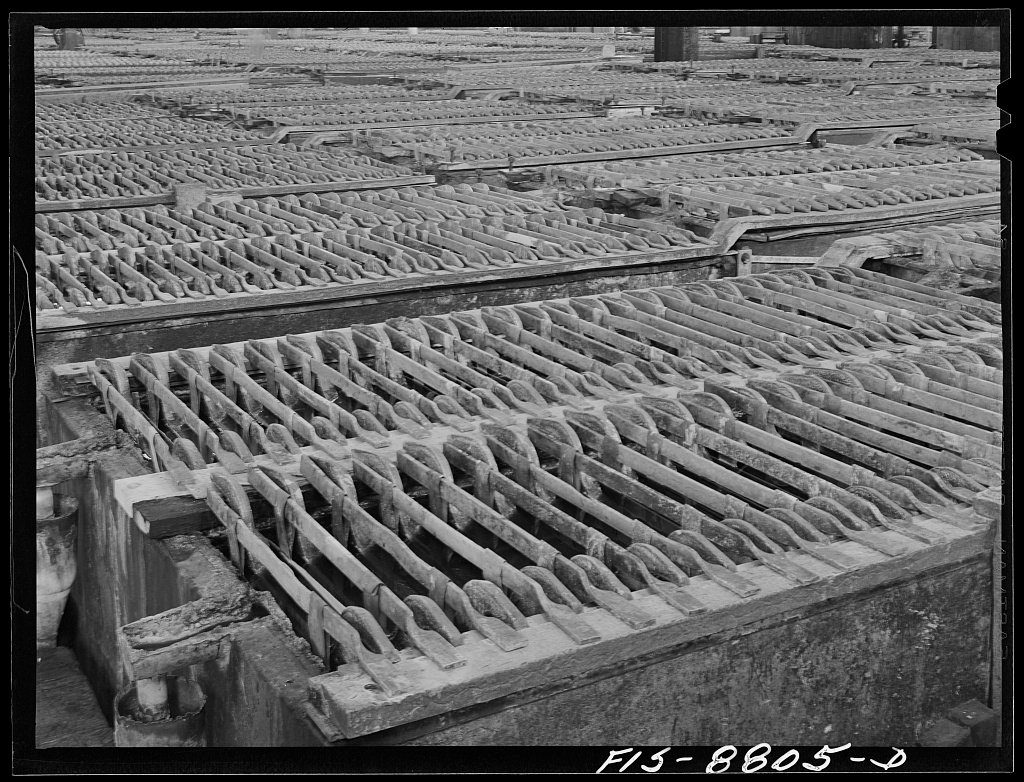
Across the Missouri, the Boston & Montana company built its copper smelter at Black Eagle in 1891–93; the Anaconda Copper Mining Company took it over in 1910. Its Big Stack, 506 feet of brick finished in 1908, was the tallest smokestack in the world until 1914 and stood over Great Falls for three-quarters of a century. Smelting ended in 1972, and the stack came down on September 18, 1982.
On Caitlin’s father’s side, the Bolands came from County Tipperary, Ireland. Patrick Boland made his home in Great Falls and raised a large family here, and family tradition ties the Bolands to the smelter across the river. His son Dick and Dick’s wife, Bev, raised their own family in Great Falls, Tom among them.
The smelter and Big Stack at Black Eagle, 1920.The Northwestern Miller, 1920, via Wikimedia CommonsThe Anaconda copper refinery in Great Falls, 1942.Russell Lee, Farm Security Administration / Library of Congress
1970s – early 2010s
Thomas E. Boland
Tom Boland was born in Great Falls in 1948. He graduated from Eastern Washington University in 1970 and the University of Montana School of Law in 1974, the year he was admitted to the Montana bar and the U.S. District Court for the District of Montana. After some years in Washington, D.C., he came home. In 1979 he opened his Great Falls practice in the office of John McCarvel, who had just taken the district court bench. He was later a partner in Regnier, Lewis & Boland, was admitted to the U.S. Supreme Court and Ninth Circuit bars, and served as a lawyer representative to the Ninth Circuit Judicial Conference from 1993 to 1996.
He was a fearless lawyer who stood up to billion-dollar companies on behalf of people who needed help getting justice, and he was not afraid of powerful adversaries. He often took the cases other attorneys did not want, because they were too hard or there was not enough money in them.
His practice was broad, and much of it was ahead of its time. He handled sexual harassment cases long before movements like Me Too brought them into the open, and in the early 1980s he took on consumer-protection cases before consumer rights were a common cause. He handled catastrophic property losses, defective products, crop losses from hail and disputed claims settlements for wheat farmers, highway design defects, medical malpractice, federal tort claims and workers’ compensation. In farm divorces involving significant agricultural assets, including Watson v. Watson and King v. King in Pondera County, he fought for fair results; in one, he won a fair division for a woman in a divorce involving a corporate wheat farm.
He never forgot that he represented people, not just cases. He kept toys, crayons and paper in the office for the families who came to see him. His daughter Caitlin often came along to depositions, sitting in the lobbies of San Francisco high-rise law offices while her father examined representatives of Fortune 500 companies.
Two of his cases show the kind of law he made. In Sherner v. Conoco he was one of the attorneys who fought for injured workers and clarified when a worker may sue an employer in tort under Montana’s Workers’ Compensation Act, a framework for employer liability that the Legislature answered the next year. In Wombold v. Associates Financial, with his co-counsel, he argued that the “points” lenders charged on real estate-secured loans were not interest at all but unauthorized fees. The Montana Supreme Court agreed, holding the practice violated the Consumer Loan Act and protecting borrowers from predatory lending.
His name appears on seventeen Montana Supreme Court decisions between 1977 and 2006, and on reported decisions in the federal courts and a tribal court of appeals. Read decade by decade, the record shows the practice he built: families, farmers, workers, borrowers and policyholders, and the rules of the game that protect all of them.
The late 1970s and 1980s: families, farms and fair process
Matter of Adoption of Hall, 173 Mont. 142 (1977). His first reported decision: a void adoption cannot be saved by delay, and custody still turns on the child’s best interests.
Phennicie v. Phennicie, 185 Mont. 120 (1979). Home-occupancy terms in a divorce are child support, and can be modified when a family’s circumstances change.
Roy v. Neibauer, 188 Mont. 81 (1980). Source of the “Roy factors” Montana courts still use to decide when to certify a partial judgment.
Gentry v. Schweiker, 513 F. Supp. 1020 (D. Mont. 1981). Federal-court review of a Social Security disability denial for a Montana worker.
Benham v. Woltermann, 201 Mont. 149 (1982). Montana policyholders protected from a void out-of-state default judgment.
Hilliard v. Schweiker, 563 F. Supp. 99 (D. Mont. 1983). The government may not apply its age grid mechanically to a disability claimant on the borderline.
In re Marriage of Watson, 227 Mont. 383 (1987). Dividing a marital estate built around a multigenerational Chouteau County ranch.
The 1990s: trial rights and the rules that decide cases
Bache v. Gilden, 252 Mont. 178 (1992). A new trial for a man hurt in a dump-truck case on a logging road, and an end to the rule that a surprise witness had to be met with a request for a continuance.
Hyde v. Evergreen Rural Fire Dept., 252 Mont. 299 (1992). Argued by Tom: the reach of immunity for rural fire departments, and whether buying insurance waives it.
Ritland v. Rowe, 260 Mont. 453 (1993). When it is unclear which statute of limitations applies, the longer period governs.
Porter v. Galarneau, 275 Mont. 174 (1996). Montana’s leading case on when new statutes and new decisions apply to pending cases.
AKA Distributing v. Whirlpool, 137 F.3d 1083 (8th Cir. 1998). A distributor’s claims against a national manufacturer, in the federal court of appeals.
The 2000s: workers, borrowers and policyholders
Sherner v. Conoco, 2000 MT 50. Injured workers may sue an employer for intentional harm. The Legislature rewrote the statute the next year.
Wolf Point v. Investment Centers, 3 Am. Tribal Law 290 (2001). The Fort Peck tribal court has jurisdiction over non-Indian defendants for claims arising on the reservation.
Osterman v. Sears, 2003 MT 327. Still the leading case on the deadline for Unfair Trade Practices Act claims against insurers.
Wombold v. Associates Financial, 2004 MT 397. Borrowers may sue under the Consumer Loan Act, and loan “points” are unauthorized fees.
Martz v. Beneficial Montana, 2006 MT 94. A consumer-lending challenge that reached the limits of federal arbitration law.
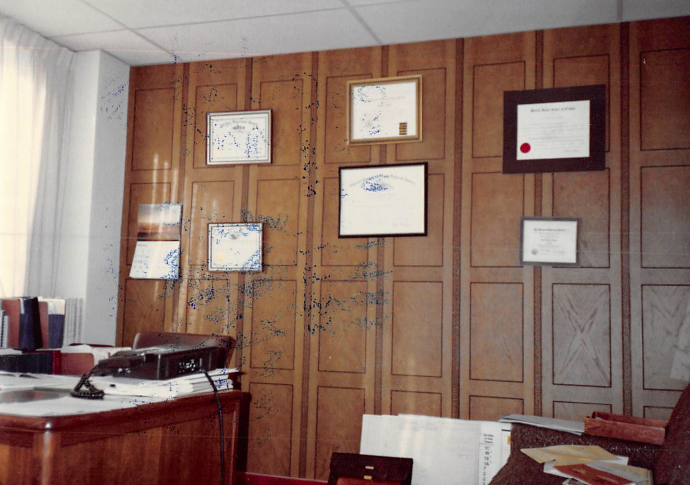
His office furniture still furnishes the firm’s offices, his awards hang on its walls, and he remains one of its steadiest supporters.
Tom Boland’s Great Falls office.Family collection
Today
Boland Aarab PLLP
In the mid-to-late 2010s, Caitlin Boland Aarab and Samir F. Aarab began preparing for, and then opened, the law firm that carries the practice Tom began forward: Boland Aarab PLLP. The work is the same work Tom did: taking on insurers, corporations and governments for people who have been hurt, and preparing every case as if it will be tried. The firm has tried more than a dozen cases to verdict before Montana juries and judges. It has spent thousands of hours in courtrooms across the state and recovered millions of dollars for its clients. When a case matters beyond the people in it, the firm takes it to the Montana Supreme Court and the federal courts of appeals, where its arguments have helped shape the law. That record is on our appellate results page. Both are members of the American Association for Justice and the Montana Trial Lawyers Association; Caitlin serves as an AAJ Governor and on the MTLA Board, and Sam is also a member of Public Justice.
In the mid-2020s the firm moved into the historic Silver State Building on 6th Street North, a few blocks from the hotel Pete Johnson built.
Six generations in Cascade County. One standard of work.
If you or someone you love has been seriously hurt, contact Boland Aarab PLLP for a free consultation at (406) 315-3737.