

Get A Free Consultation
(406) 315-3737 Get A Free Consultation
(406) 315-3737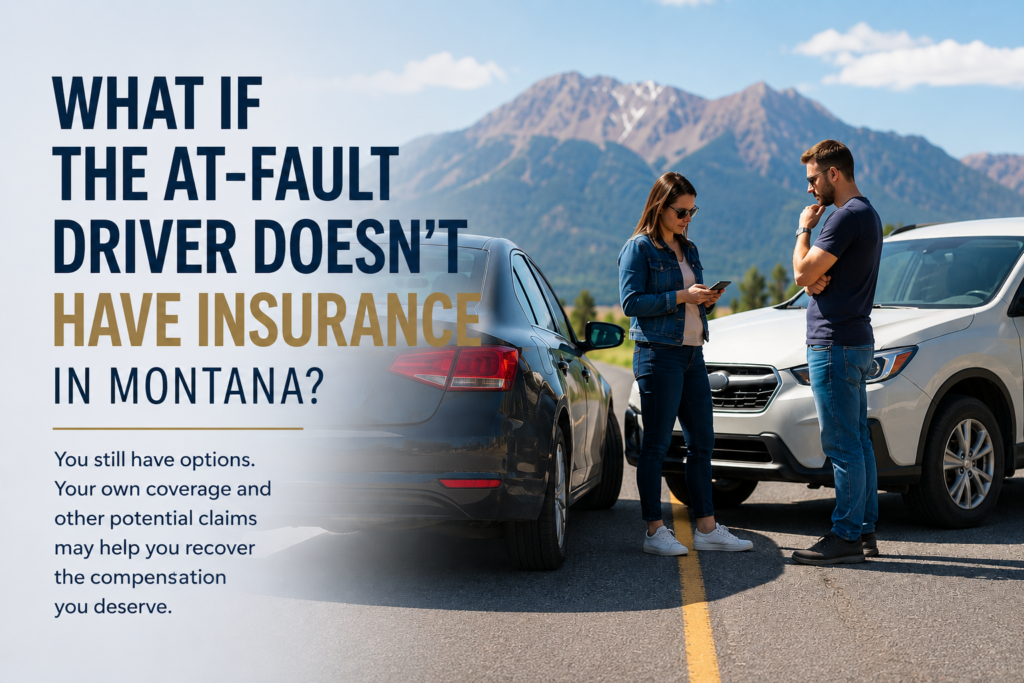
If an uninsured driver causes a crash in Montana, you may still be able to recover compensation through your own uninsured motorist coverage, collision coverage, medical payments coverage, health insurance, or a claim against the driver personally. The available options depend heavily on your insurance policy, the cause of the accident, the damages you suffered, and whether another person or business may also be legally responsible.
Montana generally requires drivers to maintain automobile liability insurance. The state’s minimum liability limits are currently:
Unfortunately, some drivers ignore that requirement, allow their policies to lapse, or carry insurance that does not apply to the particular accident.
An uninsured driver does not escape legal responsibility merely because there is no insurance company paying the claim. The driver may still be personally liable for medical expenses, lost income, property damage, pain and suffering, and other losses caused by the crash.
The practical problem is collection. A person who cannot afford insurance may also lack wages, property, or other assets that let creditors collect a judgment. That is why it is important to examine every available insurance policy and every potentially responsible party before assuming there is no source of compensation.
Montana law generally requires automobile insurers to include uninsured motorist coverage unless the named insured rejects it. The Montana Commissioner of Securities and Insurance similarly explains that an insurer must provide uninsured motorist coverage unless the insured signs a form declining it.
Uninsured motorist coverage, shown as UM on a declarations page, protects insured people who recover damages from uninsured drivers.
The Montana Supreme Court has described the purpose of uninsured motorist law as compensating innocent people injured by negligent drivers who are uninsured and financially unable to pay damages.
A UM claim is made through your own insurance company, but it is not necessarily handled like an ordinary claim in which the insurer simply pays its customer. You generally must establish that:
The precise terms of the policy matter. Disputes can arise over who qualifies as an insured, whether another liability policy applies, what damages were caused by the crash, and how much compensation is owed.
No.
Uninsured motorist coverage generally applies when there is no applicable liability insurance for the responsible driver or vehicle. Underinsured motorist coverage, commonly called UIM coverage, may apply when the at-fault driver has insurance but does not have enough coverage to compensate you fully.
For example, a driver may carry only Montana’s minimum $25,000 bodily-injury limit. If a collision causes a serious injury requiring surgery and months away from work, $25,000 may be far less than the injured person’s total damages. UIM coverage may provide an additional source of recovery, depending on the policy.
Unlike UM coverage, UIM coverage is not mandatory in Montana. The Montana Supreme Court has recognized that UIM coverage is supplemental rather than required coverage.
Do not assume that you have—or do not have—either coverage based solely on a brief conversation with an adjuster. Review the policy declarations, endorsements, rejection forms, and complete policy language.
Not necessarily.
Montana’s statutory uninsured motorist coverage primarily addresses bodily injury or death. Damage to your vehicle is often handled through other coverage, such as:
Collision coverage may pay for repairs or the value of a totaled vehicle, subject to your deductible and the terms of your policy. Your insurer may then pursue reimbursement from the responsible driver through a process known as subrogation.
When a covered vehicle is declared a total loss, Montana law restricts policy provisions that would base reimbursement solely on a generalized “book” value rather than actual replacement value, subject to the statute’s qualifications.
Keep photographs, repair estimates, towing invoices, rental-car receipts, and records of any personal property damaged in the collision. Those documents may be important even when you are dealing with your own insurer.
Several forms of coverage may be relevant while an uninsured motorist claim is pending.
Medical payments coverage, often called MedPay, may cover qualifying medical expenses regardless of who caused the collision. Its availability and limits depend on the policy.
Health insurance may pay medical bills according to the health plan’s deductibles, copayments, network requirements, and other terms. The health insurer may later claim a right to reimbursement from a settlement, so any asserted lien or reimbursement claim should be reviewed before the case is resolved.
An injured person may also have access to employer-provided disability insurance, private disability coverage, paid leave, or other benefits. Receiving those benefits does not automatically resolve the injured person’s claim for lost income or reduced earning capacity.
Because several policies may apply to the same accident, coordination among insurers can become complicated. Accepting a settlement without identifying reimbursement claims or preserving other coverage can create avoidable problems.
Yes. An injured person may bring a personal-injury or property-damage claim against an uninsured driver who caused the collision.
A lawsuit may result in a judgment against the driver. Depending on the circumstances, collection could involve available assets, nonexempt property, or garnishable income. However, a successful judgment does not guarantee immediate payment. Some defendants have few collectible assets, and bankruptcy or exemption laws may affect collection.
Before focusing exclusively on the uninsured driver, an attorney may investigate whether another person or entity shares responsibility. Depending on the facts, possible additional parties could include:
These are fact-specific possibilities, not assumptions. The evidence must support a legal basis for holding another party responsible.
Do not rely solely on what the driver said at the scene.
The vehicle may be insured even when the driver does not have an individual policy. Conversely, the driver may present an insurance card for a policy that expired, excluded the vehicle, excluded the driver, or otherwise does not cover the accident.
Coverage may potentially arise through:
Montana insurance cases demonstrate that whether a vehicle qualifies as “uninsured” can depend on both the policy wording and whether insurance applies to the ownership, maintenance, or use of the vehicle.
An attorney can request coverage information, examine policy language, and determine whether a denial should be challenged.
First, take the same safety and evidence-preservation steps that matter after any serious collision:
Seek medical attention promptly. Call law enforcement and request an official accident report. Photograph the vehicles, roadway, damage, debris, signs, and visible injuries. Obtain contact information from witnesses. Preserve dash-camera footage, text messages, and other electronic evidence.
Notify your insurer promptly, but be careful about giving a recorded statement before you understand the scope of the questions and the coverages involved. Do not sign a broad medical authorization, release, or settlement agreement without understanding its effect.
You should also obtain a complete copy of your policy—not merely the declarations page. Important rights and restrictions may appear in endorsements or other sections of the contract.
Finally, keep a file containing medical bills, wage records, mileage to appointments, out-of-pocket receipts, photographs, correspondence, and notes about how the injuries affect your daily life.
Insurance investigations and legal deadlines continue while a person receives medical care. Evidence can disappear, witnesses can become difficult to locate, and electronic data may be deleted.
Different claims can also be subject to different limitation periods, policy deadlines, notice requirements, or contractual conditions. For example, claims for injury to personal property are generally governed by a two-year Montana limitation period, although the correct deadline always depends on the precise claim and facts.
A person should not rely on a general limitation period as a calculation of the deadline in a particular case. Claims involving governmental entities, minors, deceased parties, out-of-state defendants, insurance contracts, or other special circumstances may be treated differently.
People sometimes assume that their insurer will automatically protect them because they paid premiums for UM coverage. Although insurers owe contractual and legal duties to their insureds, disagreements can still arise over:
For this reason, an uninsured motorist claim should be documented as carefully as a claim against another driver’s insurer.
Montana courts generally interpret insurance-policy language according to its ordinary meaning and evaluate ambiguity from the perspective of an average consumer who is not trained in insurance law. Whether a particular exclusion or limitation is enforceable, however, requires review of the actual policy and the circumstances of the claim.
At Boland Aarab PLLP, we understand that an uninsured-driver collision can leave an injured person feeling trapped between medical bills, vehicle repairs, missed work, and confusing insurance language. Our approach begins by listening carefully, explaining the available options in plain English, and developing a practical plan based on the client’s needs.
We investigate all potentially applicable insurance, preserve evidence, work to understand the full effect of the injuries, and communicate directly with insurers and other parties. Every case is different, and no result can be promised. Our goal is to provide compassionate, client-centered representation while pursuing a fair and legally supportable outcome.
Insurers generally must include uninsured motorist coverage unless the named insured rejects it. The policy documents and any signed rejection should be reviewed to determine whether coverage is available.
It may. When UM coverage applies, recoverable bodily-injury damages may include more than medical bills, subject to proof, policy limits, policy terms, and Montana law.
That depends on the insurer, the policy, underwriting rules, the circumstances of the accident, and applicable law. A lawyer cannot guarantee how a particular insurer will handle future premiums.
Potentially. Your insurer may seek reimbursement from the driver, or you may have a direct claim for an unpaid deductible. Actual recovery depends in part on whether the driver has collectible income or assets.
Partial responsibility may reduce or, in some circumstances, prevent a recovery under Montana’s comparative-fault rules. The outcome depends on how responsibility is allocated and on the terms of any applicable insurance coverage.
An uninsured driver does not necessarily mean that you have no claim. A careful investigation may identify UM coverage, collision coverage, medical benefits, another responsible party, or another applicable insurance policy.
Contact Boland Aarab PLLP for a free consultation at (406) 315-3737.
Legal Disclaimer
This article is provided for general informational purposes only and does not constitute legal advice. The law and insurance-policy language applicable to a particular collision may differ based on the facts, policy terms, parties, and timing. Reading this article or contacting the firm does not, by itself, create an attorney-client relationship. An attorney-client relationship is formed only through a written agreement signed by the attorney and client.
Published by Boland Aarab PLLP.