

Get A Free Consultation
(406) 315-3737 Get A Free Consultation
(406) 315-3737Published by Boland Aarab PLLP.
Yes. An insurance company or defense lawyer may review social media content and use relevant posts, photographs, comments, check-ins, or tags to challenge an injury claim. A smiling photograph, a post saying “I feel so much better today,” or a weekend check-in does not necessarily mean you are uninjured, but it may be used to argue that your pain, physical limitations, or disruption to daily life are less serious than you have reported.
For that reason, after an accident in Montana, it is safest to treat social media as potential evidence. Think carefully before posting, do not delete existing material simply because you are worried about how it looks, and speak with an attorney if you are unsure how your online activity could affect your claim.
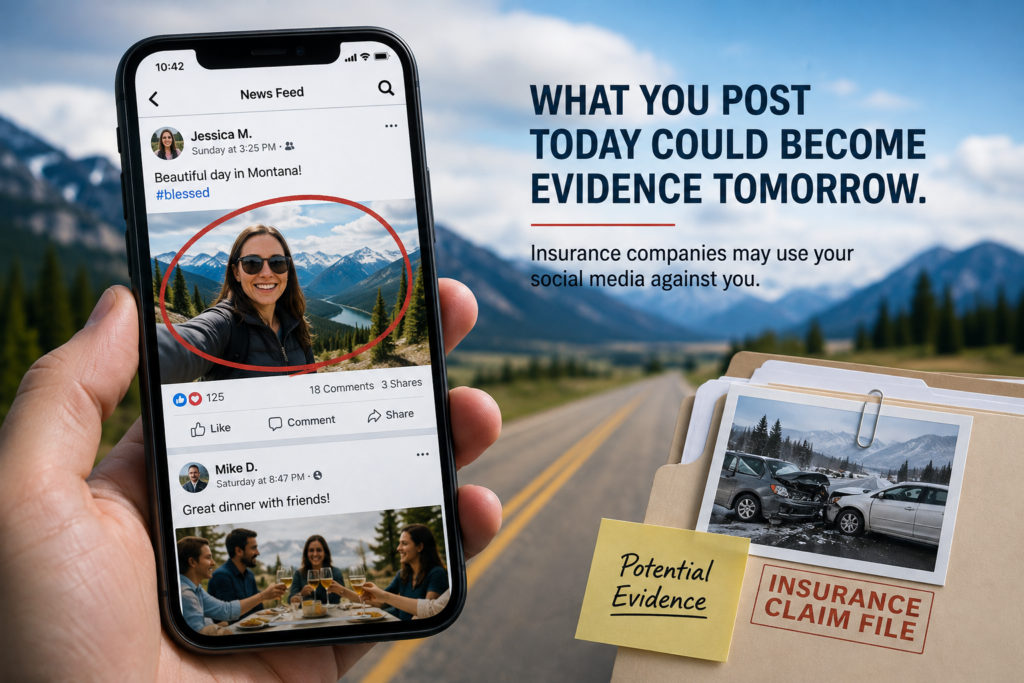
A personal injury claim often involves more than medical bills. An injured person may also seek compensation for lost income, pain and suffering, physical limitations, emotional distress, and the ways an injury has disrupted ordinary life.
Those issues can make a person’s daily activities relevant.
Suppose someone reports significant back pain that makes prolonged walking difficult. A photograph posted a few weeks later shows that person smiling beside friends at a Montana trailhead. The photograph does not reveal whether the person actually hiked, how far they walked, whether they were in pain, whether they needed medication afterward, or whether they spent the following day recovering.
But an insurer may still try to use the photograph to create a different impression.
The same problem can arise with birthday parties, weddings, vacations, sporting events, concerts, hunting trips, gym photographs, restaurant check-ins, or even an ordinary photograph in which someone happens to be smiling.
Social media captures a moment. An injury claim involves the much larger context of a person’s life.
Almost any online activity that appears inconsistent with the injuries or losses being claimed can attract attention.
That can include photographs and videos showing physical activity; comments such as “feeling great” or “finally back to normal”; check-ins at restaurants, ski areas, trails, gyms, concerts, or vacation destinations; posts about travel or recreational activities; comments about the accident itself; statements about medical treatment; and posts discussing settlement negotiations or the insurance company.
Even a joke can become a problem when it is separated from its original context.
Posts created by other people also matter. A friend may tag you in a photograph from a wedding. A family member may upload a video of a gathering. Someone may check you into a location even though you never posted anything yourself.
That does not mean every post proves anything. It means the post may become something the insurer or defense attorney wants to investigate, question you about, or place alongside your testimony and medical records.
Privacy settings are helpful, but they are not an absolute legal shield.
They can restrict what members of the public can casually see. An insurance company does not automatically gain access to everything in a private account merely because someone makes an injury claim.
The situation can change, however, if a lawsuit is filed.
Montana Rule of Civil Procedure 26 generally allows parties in litigation to obtain discovery concerning nonprivileged information that is relevant to a claim or defense. The Rule also allows courts to limit discovery that is unreasonably cumulative or whose burden outweighs its likely benefit.
Montana Rule of Civil Procedure 34 specifically addresses electronically stored information and includes writings, photographs, images, and other electronically stored data within the kinds of material that may be requested during discovery.
That does not mean the other side is automatically entitled to download a person’s entire private social-media history. Relevance still matters, and Montana courts have authority to limit inappropriate or unduly burdensome discovery and to issue protective orders.
It does mean that simply changing an account from “public” to “private” should not be viewed as a guarantee that relevant material can never become part of the case.
Potentially, yes—but discovering a social media post and admitting it into evidence are two different things.
Under Montana Rule of Evidence 401, evidence is relevant if it has a tendency to make an important fact more or less probable. Montana Rule of Evidence 403 also allows a court to exclude otherwise relevant evidence when its value is substantially outweighed by dangers such as unfair prejudice, confusion, or misleading the jury.
The party offering a photograph, message, or social media post also generally must establish that the evidence is what the party claims it is. Montana Rule of Evidence 901 addresses that authentication requirement.
In other words, a photograph on Instagram does not automatically defeat an injury claim merely because it exists. Its meaning, authenticity, relevance, timing, and context can all matter.
That distinction is important. People with serious injuries still smile. They attend their children’s graduations. They go to family dinners. They may have one relatively good afternoon surrounded by weeks of difficult days.
The concern is not that those normal moments are dishonest. The concern is that a photograph of one moment can be presented without the rest of the story.
Generally, you should not start deleting or altering potentially relevant social media content because you are worried that it may hurt your case.
Montana law recognizes a duty to preserve evidence in appropriate circumstances. In Montana State University-Bozeman v. Montana First Judicial District Court, 2018 MT 220, the Montana Supreme Court explained that a preservation duty may arise when a person or entity knows or reasonably should know that evidence may be relevant to pending or reasonably foreseeable litigation. The Court also explained that the duty can require reasonable steps to preserve relevant information rather than allowing it to be destroyed through ordinary practices.
The case involved electronic information rather than a personal-injury claimant’s social media account, but the preservation principle is important: once litigation is reasonably foreseeable, destroying or materially altering relevant evidence can create a separate problem.
If you already have posts that concern you, speak with your attorney before deleting, editing, hiding, or otherwise altering them.
A practical approach is usually better than trying to disappear from the internet overnight:
One of the most frustrating aspects of social media evidence is how easily normal human behavior can be misunderstood.
Someone recovering from an injury does not have to look miserable every hour of every day. A person can smile for a photograph while experiencing pain. Someone can attend a family event and leave early because their symptoms become overwhelming. A person may be able to perform an activity once but suffer increased pain afterward.
Those facts are why context matters.
At the same time, an insurance company handling an injury claim has an incentive to scrutinize evidence that might reduce the value of the claim. If a post appears inconsistent with someone’s testimony, medical records, or description of their limitations, the insurer may raise it during settlement negotiations, depositions, or trial.
The safest approach is not to manufacture an online image of being injured. It is simply to avoid creating unnecessary, easily misunderstood material while your claim is pending.
At Boland Aarab PLLP, we understand that an injury claim is about a person’s real life and not an isolated photograph or a few seconds of video. Our approach is client-centered, compassionate, and practical. We take the time to understand how an injury has actually affected a client’s work, family, health, independence, and everyday activities.
We also believe clients deserve practical advice about the issues that can affect a case before those issues become problems. That includes helping clients understand evidence preservation, insurance-company tactics, and the role digital information may play in modern litigation. Our goal is not to make people afraid to live their lives. It is to help them protect their rights while their claim is being evaluated.
Treat social media as potential evidence after an accident in Montana.
Privacy settings can reduce public access, but they do not necessarily prevent relevant information from becoming discoverable if a lawsuit is filed. Do not delete potentially relevant posts, do not discuss the accident or claim online, be cautious about unfamiliar friend requests, and consider speaking with an attorney before making decisions about existing content.
Yes. Information you make publicly available may be viewed and evaluated by an insurance company just like other publicly accessible information.
An insurer does not automatically have a right to your password simply because you made a claim. If litigation begins, disputes over private social-media information generally should be handled through formal discovery procedures, where relevance, scope, and appropriate protections can be addressed.
Not necessarily. The safer approach is to be cautious about what you post, avoid discussing the accident or your injuries, and speak with your attorney about your particular circumstances.
Do not panic. A tagged photograph does not automatically harm your case. Tell your attorney about anything that concerns you, and avoid asking someone to destroy existing potentially relevant material.
Do not immediately delete it. Preserve the material and discuss it with your attorney. The surrounding circumstances and context may be important.
Legal Disclaimer
This article is provided for informational purposes only and does not constitute legal advice. Every case depends on its particular facts and circumstances, and laws and court rules may change. Reading this article, using this website, or contacting Boland Aarab PLLP does not by itself create an attorney-client relationship.