

Get A Free Consultation
(406) 315-3737 Get A Free Consultation
(406) 315-3737Not necessarily. A Montana personal injury claim can settle without a trial, and even filing a lawsuit does not automatically mean you will have to testify in a courtroom before a judge or jury. If a case cannot be resolved, however, you may need to participate in a deposition, settlement conference, hearing, or eventually a trial depending on what happens in your particular case.
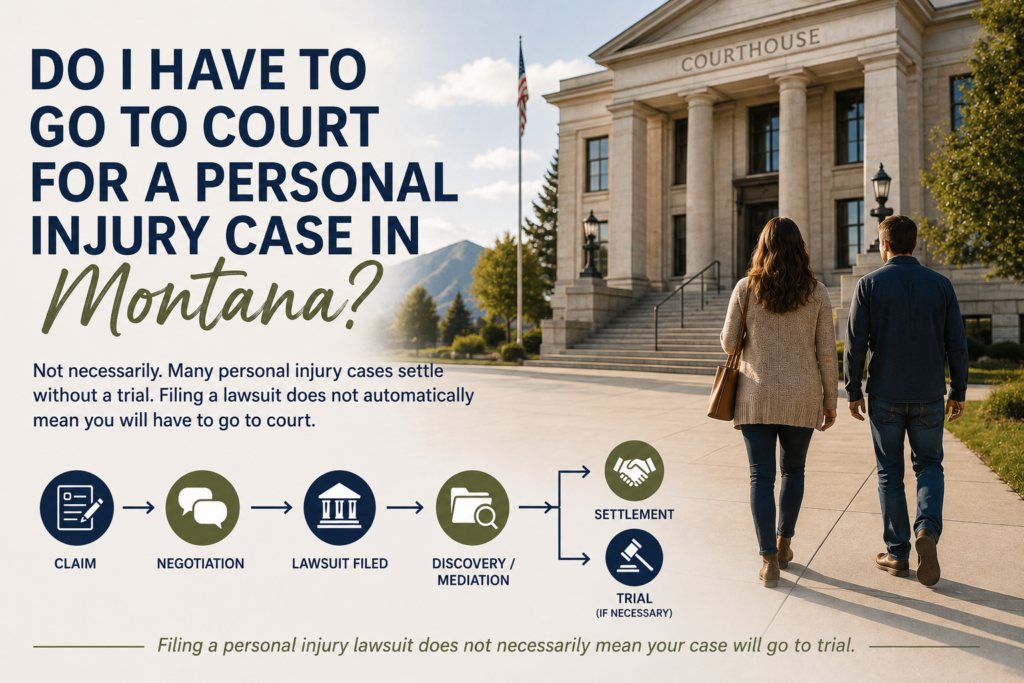
One of the biggest sources of anxiety for injured people is the word “court.” It can sound as though hiring a personal injury lawyer immediately puts you on a path toward a stressful jury trial.
That is not how every case works.
A personal injury claim can begin outside the courthouse. Your attorney may investigate what happened, collect medical records and other evidence, identify available insurance coverage, calculate your damages, and negotiate with the responsible party or insurance carrier before any lawsuit is filed.
A lawsuit begins when a complaint is filed with the court. Montana Rule of Civil Procedure 3 specifically provides that a civil action is commenced by filing a complaint.
That distinction matters: filing a lawsuit is one step in the process, not a decision that the case must go to trial.
In fact, Montana’s civil rules expressly recognize settlement as part of pretrial case management. Rule 16 identifies facilitating settlement as one of the purposes of pretrial conferences and permits courts, when appropriate, to require a party or representative to be present or available to discuss possible settlement.
Yes. A case may be resolved through a negotiated settlement before a lawsuit is filed.
For example, after the extent of the injuries becomes reasonably clear, an attorney may present the insurer with evidence concerning fault, medical treatment, lost income, future medical needs, pain, limitations, and other damages. The parties can then negotiate over an appropriate settlement.
If an acceptable agreement is reached, there may be no reason to file a traditional personal injury lawsuit at all.
Settlement can also occur after a lawsuit has been filed. Filing the complaint may introduce formal deadlines and discovery procedures, but the parties are still free to continue discussing a resolution. Montana’s civil rules contemplate settlement throughout the pretrial process rather than treating litigation and settlement as mutually exclusive paths.
That is why hearing that your lawyer recommends “filing suit” should not automatically be interpreted as, “We are going to trial.”
There are several possible reasons.
The insurance company may dispute who was responsible. The parties may disagree about how serious an injury is or what compensation is appropriate. Important evidence may need to be obtained through formal discovery. Or a legal filing deadline may be approaching.
Montana law imposes statutes of limitation on personal injury lawsuits. For many ordinary tort-based personal injury claims, that period is generally three years, although important exceptions and different deadlines can apply depending on the type of claim and the people or entities involved.
Because those deadlines can affect whether a person retains the right to pursue a claim, settlement negotiations should not be assumed to protect a filing deadline.
Filing suit can also give both sides access to formal discovery. Under Montana Rule of Civil Procedure 26, discovery can include depositions, written questions, document requests, physical or mental examinations when authorized under the rules, and requests for admission.
In other words, sometimes a lawsuit is filed because more information is needed or because a deadline must be protected but not because everyone has already decided to take the case to a jury.
Sometimes, but not necessarily for every stage of the case.
Much of civil litigation consists of work performed by the lawyers: exchanging documents, preparing written discovery, communicating with opposing counsel, briefing motions, working with experts, and preparing the case for settlement or trial.
There are, however, several points where your personal participation may be important.
A deposition is sworn testimony given before trial. The opposing lawyer asks questions, your lawyer is present, and the testimony is recorded.
A deposition is part of the discovery process; it is not itself a courtroom trial. Montana’s rules allow parties to take depositions of parties and other witnesses, and they also allow depositions to occur by telephone or other remote means when the parties agree or the court orders it.
If you are deposed, your attorney should help you understand the process beforehand. The goal is not to memorize testimony or produce perfect answers. It is to listen carefully, tell the truth, and answer the question that was actually asked.
A judge, local court rule, or the circumstances of the case may call for mediation or another settlement process. Depending on the proceeding, you may need to participate personally because settlement decisions ultimately affect your rights.
Montana’s statewide civil rules permit a court to require a party or representative to be present or reasonably available when possible settlement will be discussed. Individual judicial districts may also have their own local settlement and mediation procedures.
This still is not the same as a trial. The purpose is generally to explore whether the dispute can be resolved without one.
Occasionally, a judge may hold a hearing on a disputed issue. Whether the client personally needs to attend depends on the nature of the hearing and the court’s order.
Your lawyer should tell you when your attendance is required and what to expect.
If the case cannot be resolved and disputed issues remain for trial, then your presence generally becomes much more important.
Montana’s civil rules preserve the right to a jury trial on issues for which that right applies, provided a jury trial is properly demanded. If no jury is required or properly demanded, certain issues may instead be tried to the judge.
At a civil trial, the process is much more structured than an ordinary meeting or deposition. Depending on whether it is a jury or bench trial, proceedings can include jury selection, opening statements, witness testimony, exhibits, cross-examination, closing arguments, jury instructions, and ultimately a verdict or decision. Montana court materials describing civil trials reflect this basic sequence of presenting witnesses and evidence to the fact-finder.
Television tends to compress litigation into dramatic objections, surprise witnesses, and confrontations in front of a jury. Real civil litigation is generally more methodical.
Before any trial occurs, there is usually substantial preparation. Documents have been exchanged. Witnesses may have been deposed. The parties know the major disputed issues. Attorneys prepare exhibits, testimony, motions, and legal arguments well in advance under court scheduling requirements and Montana’s rules governing discovery and pretrial management.
If your case does reach trial, you also should not expect to be left alone to figure out what happens next. Preparing a client to testify, explaining where to be, discussing what questions may arise, and walking through courtroom procedure are important parts of trial preparation.
The possibility of trial can understandably feel intimidating. But the purpose of preparation is to make the process familiar before you ever enter the courtroom.
No.
Settlement and trial are simply different ways of resolving a civil dispute.
A fair settlement may make sense when both sides can agree on an amount that adequately resolves the claim. Trial may become necessary when the parties fundamentally disagree about fault, causation, the seriousness of the injuries, or the amount of compensation warranted by the evidence.
The decision should not be based simply on fear of entering a courthouse. It should be based on the evidence, the risks and benefits of the available options, and what makes sense for the client.
There are also no guaranteed outcomes at trial. Judges and juries evaluate evidence, witnesses, and legal arguments, and litigation always carries some degree of uncertainty.
At Boland Aarab PLLP, we believe injured people should understand what is happening in their case and why. Our role is not simply to move paperwork from one stage to another. It is to listen to what the injury has actually done to a client’s life, explain the available options in understandable language, and prepare each step of the case with the client’s needs in mind. The firm’s stated approach emphasizes individualized client service and representation of injured people and their families rather than insurance companies.
That means being prepared for both possibilities. When settlement appropriately resolves a client’s case, we pursue it thoughtfully. When litigation or trial becomes necessary, preparation matters. Our goal is to make the process as clear and manageable as possible while protecting the client’s ability to make informed decisions about their own case.
Maybe—but simply pursuing a Montana personal injury claim does not mean you are automatically headed for a jury trial.
Your case might resolve through negotiation before a lawsuit is filed. A lawsuit might be filed and later settle during discovery or mediation. Or, if an appropriate resolution cannot be reached, trial may become necessary.
The important thing is to understand the difference between making a claim, filing a lawsuit, participating in litigation, and actually going to trial. They are related, but they are not the same thing.
If the possibility of court is making you hesitate to speak with a lawyer after an injury, you do not need to decide today whether you would ever be willing to testify at trial. The first step is simply understanding your rights, your deadlines, and your options.
Yes. A claim may be negotiated without filing a lawsuit. Whether that approach is appropriate depends on the evidence, the insurer’s response, and applicable filing deadlines.
No. Filing a complaint begins the lawsuit, but settlement discussions can continue afterward, including during discovery and pretrial proceedings.
Possibly. Depositions are one of the discovery methods authorized under Montana’s civil rules, and a party may be deposed during litigation.
Yes, in appropriate circumstances. Montana Rule of Civil Procedure 30 permits a deposition by telephone or other remote means when the parties stipulate or the court orders it.
Your attorney can advise you about the strengths, risks, and value of a settlement proposal, but the decision whether to accept a settlement belongs to the client.
Questions about court should not keep you from learning what options are available after a serious injury. A consultation can help you understand whether a lawsuit is likely to be necessary, what your role would be, and how your attorney would prepare you if the case ultimately requires court involvement.
Legal Disclaimer
This article is provided for informational purposes only and does not constitute legal advice. Personal injury claims depend on their individual facts, applicable statutes, filing deadlines, court rules, and other circumstances. Reading this article or contacting Boland Aarab PLLP does not, by itself, create an attorney-client relationship.
Published by Boland Aarab PLLP.