

Get A Free Consultation
(406) 315-3737 Get A Free Consultation
(406) 315-3737Quick Answer: A wrongful death lawsuit in Montana is a civil claim brought when someone dies because of another person or company’s negligence, wrongful act, or failure to act with reasonable care. The claim allows certain family members or a personal representative to pursue financial recovery for the losses caused by the death. It is separate from any criminal case.
Losing someone unexpectedly is overwhelming. In the middle of grief, families are often left trying to make sense of what happened while also facing financial pressure and uncertainty about the future. Legal questions are rarely the first concern—but understanding your rights early can help protect your options when you are ready.
Montana law provides a path for families to seek accountability when a death should not have happened—and to address the real-world impact left behind.
A wrongful death case arises when a person’s death is caused by conduct that falls below a reasonable standard of care, or by intentional harm.
In Montana, these claims commonly involve:
The focus is not just on the loss itself—it is on whether it could have been prevented.
Every situation is different. Not every loss qualifies as a wrongful death claim, which is why careful review matters before assumptions are made.
Montana law is more flexible than some states, but it still imposes structure.
A wrongful death claim may be brought by:
In many cases, the claim is handled through the estate for the benefit of all eligible family members. If an estate has not been opened, that may be a necessary first step.
Identifying the proper party early helps avoid delays and protects the integrity of the claim.
Montana’s wrongful death law is set out in Mont. Code Ann. § 27-1-513.
The law provides that when a person’s death is caused by a wrongful act, neglect, or default, a claim may still be brought if the person could have pursued a case had they survived.
In practical terms:
Because wrongful death claims often intersect with estate law and liability issues, they can be more complex than they first appear.
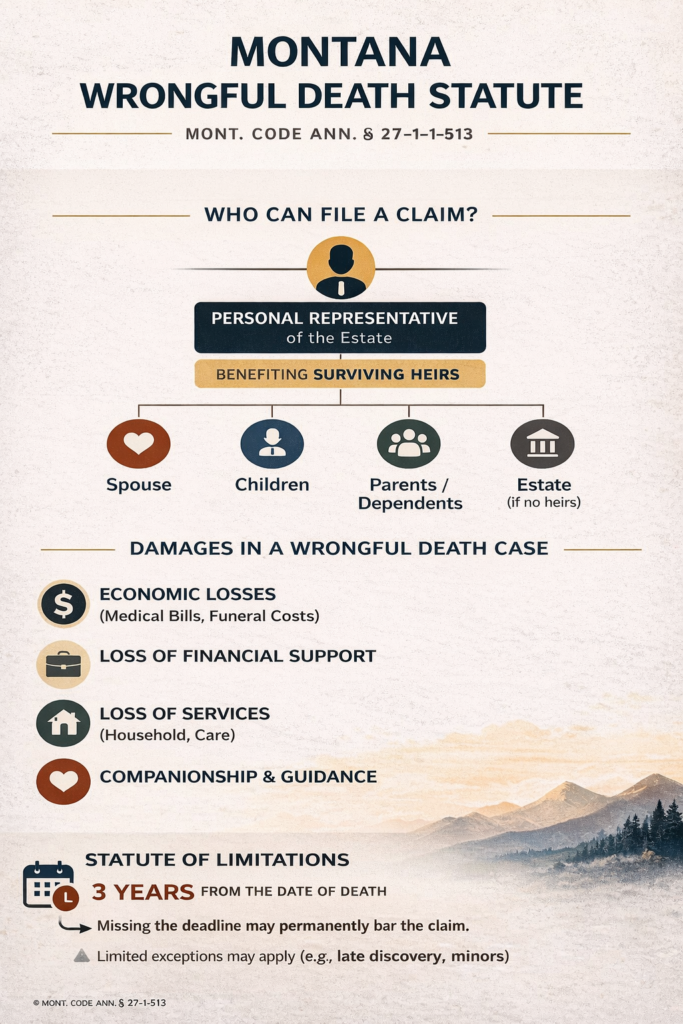
No legal action can undo a loss. The purpose of a wrongful death claim is to address the financial and personal impact on the family.
Damages may include:
In some cases, a related survival action may allow recovery for the harm the person experienced before passing.
Montana law may also allow punitive damages in limited circumstances involving particularly serious misconduct, but those are not available in every case.
These are related but distinct claims under Montana law:
Some cases involve both. Understanding how they work together can affect how a case is evaluated and resolved.
Wrongful death claims in Montana are subject to strict deadlines (statutes of limitation).
In many cases, the deadline is generally three years from the date of death, but this is not universal. Shorter deadlines or special rules may apply, including:
These deadlines are strictly enforced. Missing them can permanently bar a claim.
Strong evidence is essential to proving both liability and damages.
Key evidence often includes:
Early investigation can make a significant difference. Evidence can be lost, altered, or become harder to obtain over time.
Not always.
Some cases are resolved through settlement negotiations or mediation. Others proceed to litigation when responsibility or damages are disputed.
Either way, preparation matters. Cases that are carefully built from the beginning are often in a stronger position.
A wrongful death case is civil, not criminal.
Both can arise from the same incident, and one does not depend on the outcome of the other.
Families dealing with a loss are often navigating more than just legal questions—they are adjusting to life without someone important.
At the same time, families are dealing with grief and disruption to daily life.
Legal counsel helps by:
Having guidance can help reduce that burden and ensure important steps are handled properly.
You do not need to have everything figured out before reaching out.
An early conversation can help:
Even if you are not sure what you want to do yet, getting information early can help you make informed decisions later.
If you have lost a loved one and have questions about what happened or what comes next, you do not have to figure it out alone.
Boland Aarab PLLP represents individuals and families across Montana in serious injury and wrongful death cases. We handle the legal process so families can focus on what matters most.
Consultations are free.