Short answer: The truck accident cases that resolve at full value are built on objective, time-sensitive data and a disciplined damages analysis. Evidence must be preserved immediately, analyzed methodically, and connected directly to medical causation and long-term impact.
In a serious Montana truck accident claim, the difference between a modest settlement and full compensation often comes down to what was preserved in the first weeks after the crash.
Commercial trucking cases are different from ordinary vehicle collisions. They involve federal regulations, corporate safety systems, layered insurance policies, and electronic data that can disappear quickly. These cases are not won by argument. They are won by records.

Why Evidence Matters More in Trucking Cases
Commercial motor carriers operate under the Federal Motor Carrier Safety Regulations (FMCSRs), which govern driver qualifications, hours of service, maintenance programs, inspection requirements, and safety management systems.
When a crash occurs, the investigation must determine:
- Whether the driver was fatigued or over-scheduled
- Whether the truck was properly maintained
- Whether cargo was loaded and secured correctly
- Whether dispatch or broker pressure compromised safety
Unlike a standard car crash, a trucking case often involves multiple responsible entities. The evidence must uncover system failures — not just individual mistakes.
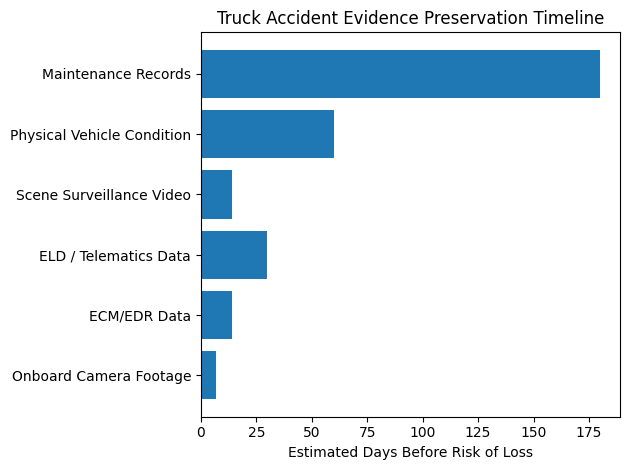
Black Box (ECM/EDR) Data: The First Priority
Most commercial tractors contain an Engine Control Module (ECM) or Event Data Recorder (EDR). These systems can capture speed, braking, throttle input, deceleration, and other mechanical data in the seconds surrounding impact.
That data is not permanent.
Ignition cycles and continued vehicle operation can overwrite critical information. Immediate spoliation notices should demand preservation of:
- The tractor and trailer in post-collision condition
- ECM/EDR downloads
- Telematics records
- Safety-event data
- Onboard camera footage
Once lost, this data cannot be recreated through testimony.
Hours-of-Service and Fatigue Analysis
Federal Hours-of-Service rules limit how long commercial drivers may operate without rest.
Electronic Logging Devices (ELDs) record driving time and rest breaks. On paper, logs may appear compliant. A deeper review often reveals more.
ELDs should be compared with GPS tracking, fuel receipts, weigh station entries, toll records, and dispatch communications. Patterns of unrealistic scheduling, improper off-duty toggling, or compressed delivery windows may support a fatigue or corporate-pressure theory.
In Montana, where long rural highways and winter conditions amplify risk, fatigue-related crashes are particularly serious.
Road-Facing Video and Telematics
Many fleets use forward-facing cameras integrated with telematics systems. These systems frequently overwrite within days.
Video may show following distance, lane discipline, traffic conditions, and driver attentiveness. When synchronized with mechanical data, it provides a powerful reconstruction tool.
Immediate preservation letters should specifically demand full-resolution footage and metadata. Early investigation should also identify nearby businesses or public facilities that may have captured approach angles.
Maintenance, Brake Systems, and Inspection Records
Commercial carriers are required to implement systematic inspection, repair, and maintenance programs under federal law, specifically Maintenance Regulations, which mandate regular inspections, documented repairs, and safe operating condition standards for commercial motor vehicles.
Brake measurements, service orders, inspection intervals, and Driver Vehicle Inspection Reports (DVIRs) often reveal whether safety standards were followed.
Patterns of deferred maintenance, unresolved violations, or repeated out-of-service findings may expand liability beyond the driver to the motor carrier’s safety management system.
Cargo Securement and Loading Liability
Improperly loaded or secured cargo can cause jackknifes, rollovers, and lane intrusions. These risks are governed by the Federal Cargo Securement Rules, which establish detailed standards for load distribution, tie-down requirements, working load limits, and methods of securing specific types of cargo.
Bills of lading, weight tickets, and loading documentation help determine whether a shipper, broker, or third-party loader contributed to the hazard. In many cases, multiple insurance policies may apply.
Comparative Fault in Montana
Montana applies modified comparative negligence under § 27-1-702, MCA.
An injured person may recover damages so long as they are not more than 50% at fault.
In trucking cases, defendants often argue that a passenger vehicle “cut off” the truck or braked suddenly. Reconstruction using ECM data, video evidence, perception-reaction timing, and stopping-distance modeling frequently reduces inflated fault claims.
Fault allocation directly affects recovery. Objective data matters.
Medical Causation and Long-Term Damages
Liability proof alone does not determine value. Medical documentation must establish:
- Clear connection between crash and injury
- Objective diagnostic findings
- Consistent treatment history
- Functional limitations
- Future medical needs
In serious cases, coordinated expert analysis may include life-care planning, vocational assessment, and economic present-value modeling. This converts medical records into a defensible long-term damages projection.
Pre-Existing Conditions and the “Eggshell Plaintiff” Rule
Montana law recognizes that a defendant takes a person as they are. If a crash aggravates or accelerates a pre-existing condition, that aggravation may be compensable.
The issue becomes medical differentiation — what was baseline function before the crash, and what changed afterward? Comparative imaging, prior records, and treating physician opinions are central to that analysis.
Deadlines: Legal and Electronic
Most Montana personal injury claims must be filed within three years under § 27-2-204, MCA.
Public-entity claims may involve additional notice requirements. At the same time, electronic evidence may auto-delete quickly.
Both legal and technological deadlines require immediate action.
At Boland Aarab PLLP, serious truck accident cases are prepared from day one as if they will be tried to a jury. That means moving immediately to preserve electronic data, securing corporate records before they disappear, and structuring inspections under documented protocols.
We focus on disciplined investigation, credible expert involvement, and a damages model grounded in medical reality and economic analysis. Preparation creates leverage. When insurers see a case supported by preserved black-box data, coordinated expert analysis, and trial-ready presentation, negotiations shift from resistance to resolution.
Frequently Asked Questions
How long do I have to file a truck accident lawsuit in Montana?
In most cases, three years from the date of injury. Claims involving government entities may have shorter notice requirements. Waiting can also result in lost electronic evidence.
What is black box data in a semi-truck?
It is electronic information stored in the truck’s engine control module or event data recorder. It may capture speed, braking, and other mechanical inputs before impact. This data can be overwritten without prompt preservation.
Can more than one company be responsible?
Yes. Trucking cases often involve the driver, the motor carrier, maintenance contractors, brokers, shippers, or loading companies. Identifying all responsible entities is often critical to full recovery.
What if I had a prior injury?
If the crash aggravated or accelerated a pre-existing condition, Montana law may still allow recovery for the worsening of that condition. Medical documentation distinguishing baseline from post-crash function is key.
Do I need to complete treatment before pursuing a claim?
Not necessarily. What matters is having a medically supported plan outlining future care and long-term impact with reasonable certainty.
Disclaimer
This article is provided for general informational purposes only and does not constitute legal advice. Every case is fact-specific, and outcomes depend on the particular circumstances and applicable Montana and federal law. Viewing this material or contacting Boland Aarab PLLP does not create an attorney-client relationship. If you believe you may have a claim, you should consult directly with qualified counsel regarding your specific situation and applicable deadlines.

