

Get A Free Consultation
(406) 315-3737 Get A Free Consultation
(406) 315-3737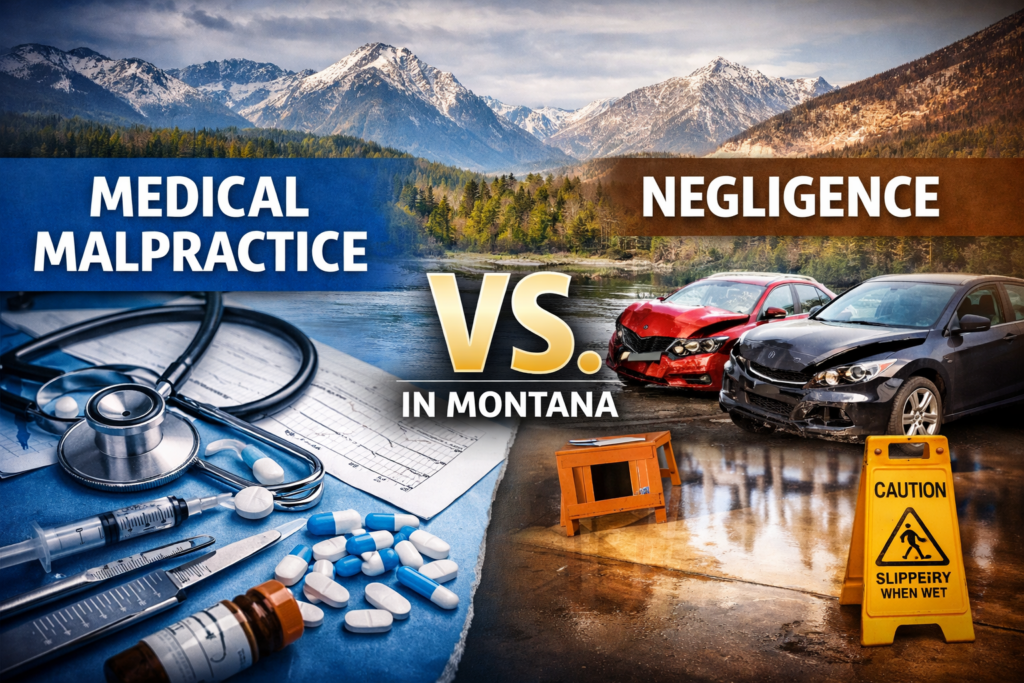
When someone is injured because another person failed to act carefully, most people assume the situation is straightforward. Someone made a mistake, someone got hurt, and the injured person should be compensated. In many cases, that is true. But in Montana, the legal path forward often depends on one key question: does the claim involve medical malpractice, or is it a general negligence case?
Although both malpractice and negligence involve harm caused by a failure to use proper care, Montana law treats medical malpractice differently in several important ways. Those differences can affect filing deadlines, proof requirements, and the amount of work needed to build a case before it ever reaches a courtroom.
At Boland Aarab PLLP, we have been around the block. We understand how insurance carriers and defense counsel approach these cases, and we know that properly identifying the type of claim early is often one of the most important steps in protecting an injured person’s rights.
Negligence is a broad legal concept that applies to many types of injury cases. It involves a failure to act with reasonable care under the circumstances. Medical malpractice, however, is a specialized form of negligence that applies specifically to healthcare providers and is measured against a professional medical standard of care.
In a typical negligence case, the law asks what a reasonable person would have done. In a malpractice case, the law asks what a reasonably competent healthcare provider would have done under similar circumstances.
That difference might seem subtle, but in litigation, it changes the entire structure of the case.
Medical malpractice occurs when a healthcare provider fails to provide treatment consistent with the accepted standard of care, and the patient is harmed as a result. These cases may involve a doctor, nurse, hospital, clinic, or other licensed medical professional.
Some malpractice cases involve obvious errors, such as surgical mistakes or medication problems. Other cases are harder to detect at first, including failures to diagnose, failures to order testing, or delayed treatment that allows a condition to worsen.
To prove medical malpractice, a plaintiff generally must establish:
Because malpractice cases often involve technical medical questions, expert testimony is usually necessary to establish what the standard of care required and how it was violated.
General negligence refers to a failure to use reasonable care in everyday situations. Unlike malpractice, negligence claims can involve almost anyone, including individuals, businesses, landlords, drivers, manufacturers, and property owners.
These cases frequently involve car crashes, unsafe property conditions, defective products, or other preventable hazards.
Most negligence claims require proof of the same basic elements:
While the structure is similar to malpractice, negligence cases are often proven through factual evidence such as accident reports, witness testimony, photographs, and video footage, rather than specialized professional standards.
Although both claims involve similar elements, Montana law treats malpractice and negligence differently in several practical ways.
One major difference is the statute of limitations. Medical malpractice claims generally have a shorter filing deadline than negligence claims. That matters because malpractice injuries are not always immediately obvious, and many patients only discover the issue after their condition worsens or another provider identifies the problem.
Another major difference is expert testimony. In most malpractice cases, it is not enough to argue that a provider made a mistake. A qualified medical expert is usually required to explain what the standard of care was and how the provider deviated from it. Without that testimony, malpractice cases can be difficult to pursue, even where the injury is severe.
Negligence cases may still involve experts in certain circumstances, but many can be proven through common-sense evidence that jurors can evaluate without specialized medical knowledge.
Medical malpractice cases are often more complex than ordinary negligence claims because they involve complicated medical facts and competing explanations for what caused the injury. Defendants frequently argue that the patient’s outcome was unavoidable, or that the injury was caused by an underlying medical condition rather than negligent treatment.
These cases often require detailed record review, expert evaluation, and careful causation analysis. It is not enough to prove that a bad outcome occurred. The plaintiff must show that the injury resulted from a deviation from the standard of care, and that the harm would not have occurred otherwise.
In Montana, medical malpractice cases can also involve additional procedural hurdles before a lawsuit is even filed. Many malpractice claims are first submitted to the Montana Medical Legal Panel, a pre-litigation review process intended to evaluate whether the claim has merit. The panel’s purpose is to help screen out unsupported claims early and encourage resolution of valid cases before full litigation begins. However, the panel’s opinion is not a final decision on the case, and it is not required in order to file a lawsuit in court. Even so, the process can add time and complexity to malpractice cases and often requires careful preparation of medical records and expert support early in the case.
Both medical malpractice and negligence claims may involve significant damages. Injuries can lead to expensive medical care, lost income, and long-term disability.
In both types of cases, a plaintiff may seek compensation for medical expenses, lost wages, reduced earning capacity, and future treatment needs. Plaintiffs may also seek non-economic damages such as pain and suffering, emotional distress, and loss of enjoyment of life.
In malpractice cases in particular, damages may involve long-term care planning and extensive documentation of future medical needs, which often requires expert support.
The difference between malpractice and negligence is not just technical. It affects deadlines, the type of proof required, the costs of litigation, and the defenses that will be raised.
Many injured people do not realize that medical malpractice claims can involve faster deadlines and more demanding evidence requirements than other injury cases. Because of that, early evaluation is critical. Waiting too long can make it harder to obtain records, locate witnesses, or meet filing requirements under Montana law.
If you believe you were injured due to medical error or preventable negligence, it is important to speak with an attorney promptly. Evidence can disappear, records can become harder to obtain, and legal deadlines may pass sooner than expected.
At Boland Aarab PLLP, we have experience handling serious injury litigation across Montana. We know how these cases are built, how they are defended, and what it takes to pursue meaningful results for clients.
We encourage prospective clients to review our testimonials to learn more about what it is like to work with our firm.
📞 Call today to schedule a consultation.
📍 Proudly serving clients throughout Montana.
Negligence is a broad legal claim based on failure to use reasonable care. Medical malpractice is a specialized type of negligence that applies only to healthcare providers and is judged based on the medical standard of care.
Often, yes. Medical malpractice usually requires expert testimony to establish the standard of care and to show how the provider violated it. Many negligence claims can be proven through direct factual evidence without expert medical support.
Medical malpractice claims in Montana generally must be filed within two years from the date of injury, or from when the injury was discovered or reasonably should have been discovered. Because the deadline may depend on the facts, legal review should occur as early as possible.
General negligence claims in Montana typically must be filed within three years of the date of injury.
Most do. Because jurors are not expected to know medical standards, expert testimony is usually required to establish what should have been done and whether the provider’s actions caused the injury.
Yes. Certain cases may involve overlapping theories. For example, a hospital may be negligent in its procedures while a provider may be liable for malpractice in medical decision-making.
The best step is to act quickly. Gathering records, identifying witnesses, and evaluating deadlines early can significantly affect the strength of a case.
Disclosure: This blog is for general informational purposes only and does not constitute legal advice or create an attorney-client relationship.