

Get A Free Consultation
(406) 315-3737 Get A Free Consultation
(406) 315-3737
Insurance plays a major role in modern economies. It protects individuals, businesses, and communities from the financial consequences of accidents, negligence, and unexpected losses.
However, how insurance works can feel confusing—especially after an accident or injury. Below is a straightforward explanation of the key concepts behind insurance and how it applies to personal injury claims in Montana.
Insurance systems are designed to manage financial risk. Instead of one person bearing the full cost of an accident or injury, insurance spreads that risk across many people.
Insurance works by pooling risks. Many people pay premiums into a shared fund. When an accident occurs, that pool of funds helps cover the losses.
For a deeper explanation of the risk-pooling model, see the Insurance Information Institute overview of how insurance works:
https://www.iii.org/article/insurance-101
By spreading financial risk, insurance allows individuals and businesses to operate without the constant fear of catastrophic losses.
This stability is one reason insurance systems are essential in developed economies.
Many types of insurance are required by law to protect the public.
Montana drivers must carry minimum liability coverage under state law. This ensures that injured people have access to compensation after a crash.
You can review Montana’s legal insurance requirements here:
https://archive.legmt.gov/bills/mca/title_0610/chapter_0060/part_0010/section_0030/0610-0060-0010-0030.html
Businesses often carry general liability insurance to protect against claims of negligence, such as:
customer injuries on property
defective products
workplace incidents
This coverage helps businesses remain financially stable when legal claims arise.
Some professions—especially those involving public safety—require specialized insurance.
Examples include:
doctors (medical malpractice insurance)
contractors
certain licensed professionals
These policies protect both professionals and the public if negligence claims arise.
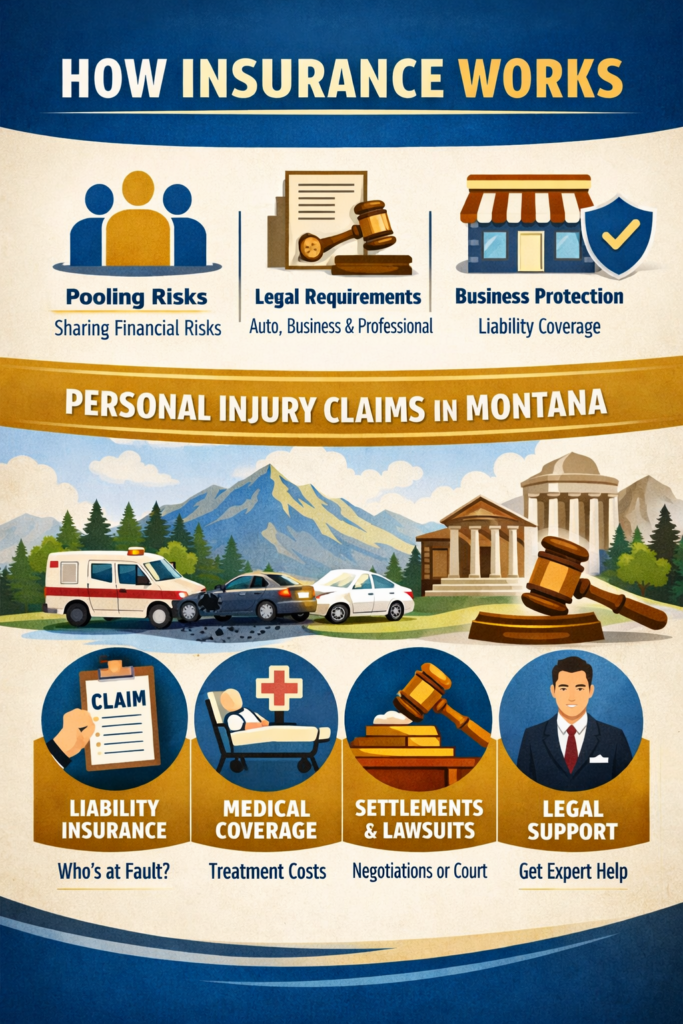
Insurance plays a central role in most personal injury claims.
If someone is injured because of another person’s negligence, the at-fault party’s insurance typically handles the claim.
Liability insurance covers damages when someone is responsible for harming another person.
Common forms include:
Covers medical costs, lost wages, and other damages when someone is injured.
Pays for damage to vehicles, buildings, or other property.
For a detailed explanation of these coverages, see the National Association of Insurance Commissioners guide:
https://content.naic.org/consumer/auto-insurance.htm
Sometimes injured individuals rely on their own insurance policies.
Common first-party coverage includes:
Medical Payments Coverage (MedPay) – pays medical bills regardless of fault
Personal Injury Protection (PIP) – covers medical costs and lost wages in some states
Uninsured/Underinsured Motorist Coverage – applies when the at-fault driver lacks enough insurance
These protections can be critical after serious accidents.
After an accident, the claim process usually follows several steps:
Report the accident
Insurance investigation
Medical record review
Liability determination
Settlement negotiation
Many claims resolve through settlement negotiations.
However, if the insurance company refuses to offer fair compensation, a personal injury lawsuit may be necessary.
Montana has strict laws governing how insurance companies must handle claims.
These rules are found in Title 33 of the Montana Code Annotated.
One of the most important statutes is:
Unfair Claim Settlement Practices Prohibited — MCA §33-18-201
You can review the statute here:
https://leg.mt.gov/bills/mca/title_0330/chapter_0180/part_0020/section_0010/0330-0180-0020-0010.html
This law prohibits insurance companies from:
misrepresenting policy provisions
failing to promptly investigate claims
delaying payment when liability is clear
forcing claimants into unnecessary litigation
These protections exist to ensure insurance companies treat claimants fairly.
Insurance companies have experienced adjusters and attorneys whose job is to limit payouts.
That does not always align with the injured person’s best interests.
A personal injury attorney can help by:
explaining insurance coverage
gathering medical evidence
negotiating with insurers
filing lawsuits when necessary
Many law firms offer free consultations for injury cases.
Most personal injury claims settle without going to court. But sometimes litigation becomes necessary.
A lawsuit may be filed when:
the insurance company denies liability
the settlement offer is too low
the insurer delays the claim unreasonably
The legal process typically involves:
filing a complaint
exchanging evidence (discovery)
depositions
settlement negotiations
trial if necessary
In Montana, personal injury cases are usually filed in state district court.
More information about Montana courts can be found here:
https://courts.mt.gov
Insurance disputes can be stressful and complicated.
At Boland Aarab, we help clients understand their rights and pursue fair compensation after injuries.
Our firm assists with:
car accident claims
serious injury cases
insurance disputes
litigation when necessary
Whether a case settles through negotiation or proceeds to trial, our goal is the same: helping clients obtain fair compensation under Montana law.
If you are dealing with an insurance claim after an accident, understanding your rights is important.
Speaking with an experienced Montana personal injury lawyer can help you navigate the process and avoid costly mistakes.
Learn more or request a consultation here:
https://www.bolandaarab.com/great-falls-personal-injury-lawyers-contact-us/