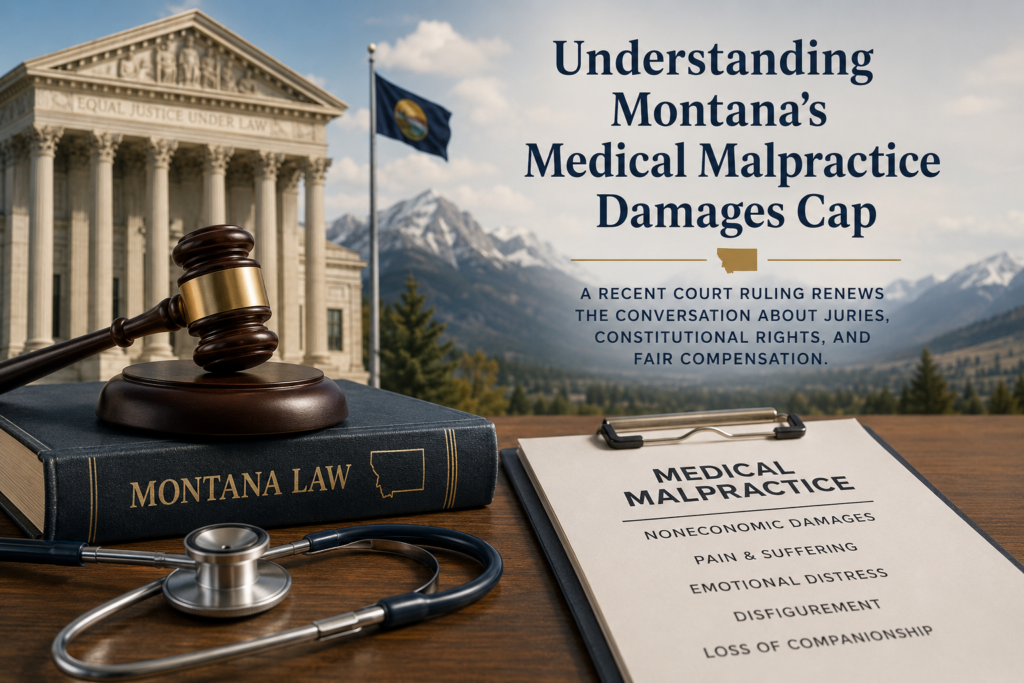
Montana law has long placed a statutory limit on the noneconomic damages such as, pain, emotional distress, and disfigurement, that an injured patient may recover in a medical malpractice case. But a recent Cascade County District Court ruling in a case handled by Boland Aarab PLLP held that Montana’s medical malpractice damages cap is unconstitutional and may not be used to limit the jury’s verdict in that case.
The cap has not disappeared from the Montana Code. One district judge has declined to apply it to one verdict. The constitutional question behind that refusal will be settled, if it is settled at all, on appeal.
What Is Montana’s Medical Malpractice Damages Cap?
Montana Code Annotated § 25-9-411 limits the amount of noneconomic damages that may be recovered in certain medical malpractice cases.
Noneconomic damages are different from losses that can be calculated from a bill, paycheck, or receipt. Under Montana law, they include losses such as:
- physical and mental pain or suffering;
- emotional distress;
- inconvenience;
- impairment or disfigurement;
- loss of society, companionship, or consortium;
- injury to reputation; and
- humiliation.
The statute is directed specifically at these subjective, nonmonetary harms.
For many years, Montana’s statutory limit was $250,000 for past and future noneconomic damages arising from a single incident of medical malpractice. The Legislature originally enacted that limitation in 1995. Historical versions of § 25-9-411 also prohibited the amount of the cap from being disclosed to the jury.
The verdict and the recovery were therefore two different numbers, and the jury was told only the first. A jury could hear all of the evidence about a person’s pain, permanent impairment, emotional injury, or disfigurement and determine that the harm was worth substantially more than the statutory maximum. Under the cap, however, the amount recoverable for those noneconomic losses could still be reduced after the verdict.
Did Montana Change the Medical Malpractice Cap in 2025?
Yes.
In 2025, the Montana Legislature passed House Bill 195, which substantially revised § 25-9-411. The legislation increased the noneconomic-damages limit and created a schedule of future increases.
Under the current statutory schedule, the limit is:
$300,000 initially under the 2025 amendment;
$350,000 beginning January 1, 2026;
$400,000 beginning January 1, 2027;
$450,000 beginning January 1, 2028; and
$500,000 beginning January 1, 2029.
Beginning in 2030, the statute calls for the limit to increase by 2% each year.
The applicable amount generally depends on when the claimant first files the claim with the Montana Medical Legal Panel. For claims not subject to the Medical Legal Panel process, the statute looks to when the lawsuit is first filed.
Two patients injured by the same conduct may therefore face different ceilings, depending only on when each claim was filed. Older claims remain governed by the earlier, lower version of the cap.
What Doesn’t the Cap Limit?
Section 25-9-411 limits noneconomic losses and nothing else. It is not a ceiling on every category of compensatory damages a patient may claim.
Economic damages can include measurable financial losses such as medical expenses, lost earnings, loss of earning capacity, and certain future financial costs caused by an injury. Noneconomic damages address harms that are real but cannot be established simply by adding up invoices.
This distinction can have an especially significant impact on people whose injuries produce extraordinary pain, disability, disfigurement, or loss of quality of life without producing equally large economic expenses.
For example, two patients could experience dramatically different financial losses from similar permanent injuries. A person who has significant lost income and medical expenses may have substantial economic damages. Another person suffering profound noneconomic harm may have fewer measurable financial losses.
A cap on noneconomic damages falls almost entirely on the second.
Why Did Montana Create the Cap?
The medical malpractice cap was enacted in 1995 as part of a broader debate over medical liability, malpractice-insurance premiums, access to physicians, and health-care costs.
Supporters told lawmakers that limiting unpredictable noneconomic damage awards could help stabilize malpractice-insurance costs and assist physicians, particularly those practicing in high-risk specialties or rural communities. Legislative testimony supporting the bill specifically connected the proposed $250,000 cap to malpractice premiums and the availability of medical services.
The premise was contested from the outset.
The legislative record also included evidence questioning whether Montana was experiencing a malpractice crisis requiring this type of tort reform and whether limiting damages would actually produce savings for health-care providers or patients. During the 1995 House Judiciary Committee hearings, lawmakers heard testimony that the available evidence did not establish that tort reform would result in health-care cost savings.
The constitutionality of the cap is not a referendum on whether damages limits are sound policy. A court must instead examine the relationship between the classifications created by the law, the governmental interests offered to justify those classifications, and rights guaranteed by the Montana Constitution.
Why Has the Cap Been Challenged as Unconstitutional?
Several provisions of Montana’s Constitution bear directly on civil litigation, among them the right to full legal redress and the guarantee that trial by jury remain inviolate.
Challenges to the medical malpractice cap have raised several constitutional concerns, including the rights to equal protection, legal redress, due process, and trial by jury, as well as constitutional restrictions involving special privileges and immunities, special legislation, and separation of powers.
The central question is narrow:
If a jury hears the evidence and determines how much a person’s noneconomic injuries are worth, can the Legislature require a court to substitute a predetermined statutory amount for the jury’s factual determination?
The Montana Constitution provides that the right to trial by jury is secured to all and “shall remain inviolate.” The jury’s authority to fix damages has therefore been central to the challenge.
The statute also treats identical injuries unequally.
A person catastrophically injured by ordinary negligence generally does not face § 25-9-411’s medical malpractice limitation. But a person suffering the same type and severity of injury because of medical negligence may be subject to the statutory limit.
Within the group of medical malpractice victims, the cap can also have very different practical consequences. Someone whose noneconomic damages are below the statutory amount can potentially recover all of those damages. Someone with much more severe noneconomic injuries may recover only a portion of the amount the jury determines would fairly compensate the harm.
Courts weighing § 25-9-411 against the Montana Constitution have been asked to resolve these questions.
What Did the Recent Montana Court Ruling Decide?
In August 2026, the Montana Eighth Judicial District Court in Cascade County ruled on the constitutionality of § 25-9-411 in a medical malpractice case handled by Boland Aarab PLLP.
Boland Aarab challenged § 25-9-411 before trial and asked the Court to prevent the defendants from using the statutory cap to limit a future jury verdict.
The Court granted our motion for partial summary judgment.
Judge Elizabeth Best concluded that the statute could not constitutionally be applied to limit the jury’s verdict. The Court found constitutional problems involving equal protection, legal remedy and full legal redress, due process, the right to trial by jury, special immunities, separation of powers, and special legislation. The Court also independently concluded that the statute was unconstitutional as applied in the case before it.
In our view, the order returns to the jury a judgment the Legislature had taken from it: what an injured person’s losses are worth.
The Court did not decide what damages should be awarded. That remains a matter for the litigation process and, where appropriate, the jury.
Does This Mean Montana’s Medical Malpractice Cap Is Now Gone?
Not statewide—not yet.
The August 2026 decision is an order from a Montana district court. A district court order binds the parties before it. It does not carry the statewide precedential authority of a Montana Supreme Court decision.
Other Montana trial courts have considered challenges involving § 25-9-411 and have not always reached the same conclusion. Judge Best’s order expressly recognized those differing district court decisions and explained why the Court disagreed with them.
For that reason, Montana patients and lawyers should not assume that § 25-9-411 has simply disappeared from the Montana Code.
The statute remains published in the Montana Code Annotated, including the limits enacted by the Legislature in 2025.
What has changed is that another Montana court has confronted the constitutional question directly and held that the cap cannot limit a jury’s verdict in the case before it. Whether other courts follow it remains open.
Why Does This Issue Matter to Injured Patients?
Some injuries cannot be adequately described on a spreadsheet.
A medical bill can place a dollar amount on surgery. Payroll records can establish lost wages. An economist may be able to calculate future earning losses.
There is no comparable invoice for permanent pain.
There is no receipt for losing the ability to participate in activities that once defined someone’s life. There is no simple formula for disfigurement, emotional suffering, loss of companionship, or the loss of independence that can accompany a life-changing injury.
Those are precisely the kinds of losses juries are asked to evaluate as noneconomic damages.
The debate over Montana’s medical malpractice cap is therefore ultimately about more than a particular dollar amount. It raises a fundamental question about who should determine the value of those losses after hearing the evidence in an individual case.
The Boland Aarab Way
At Boland Aarab PLLP, we approach serious injury and medical malpractice cases from the perspective that every client’s circumstances are different. A statute, insurance policy, or damages formula rarely tells the complete story of what an injury has actually done to a person’s life.
The Boland Aarab way is client-centered, compassionate, and practical. We listen first, investigate carefully, and then determine what legal strategy gives our client the strongest opportunity for a fair result. When an existing law may improperly restrict a client’s constitutional rights, that can also mean being willing to challenge the law itself.
Frequently Asked Questions About Montana’s Medical Malpractice Cap
What are noneconomic damages in a Montana medical malpractice case?
They can include pain and suffering, emotional distress, inconvenience, impairment, disfigurement, loss of companionship or consortium, injury to reputation, and humiliation.
What is Montana’s medical malpractice noneconomic damages cap in 2026?
Under the schedule enacted in 2025, the statutory limit is $350,000 beginning January 1, 2026. The amount applicable to a particular claim can depend on when the claim was first filed.
Does the medical malpractice cap limit medical bills and lost wages?
Section 25-9-411 specifically limits noneconomic damages. Economic damages such as medical expenses and lost earnings are separate categories of damages.
Did a Montana court recently find the cap unconstitutional?
Yes. In August 2026, a Cascade County District Court granted a constitutional challenge brought by Boland Aarab PLLP and held that § 25-9-411 could not limit the jury’s verdict in that case.
Does that ruling guarantee the same result in every Montana medical malpractice case?
No. It is a district court ruling, and the law may continue to develop through other cases and potential appellate review.
Speak With a Montana Medical Malpractice Attorney
Medical malpractice cases can involve complicated questions about medicine, expert testimony, damages, filing deadlines, and the application or constitutionality of Montana statutes.
Legal Disclaimer
This article is for informational purposes only and does not constitute legal advice. Reading this article or contacting Boland Aarab PLLP does not create an attorney-client relationship. Every case depends on its individual facts and applicable law. Court rulings discussed in this article may be subject to additional proceedings or appellate review, and no past result guarantees a particular outcome in another case.
Published by Boland Aarab PLLP.

